


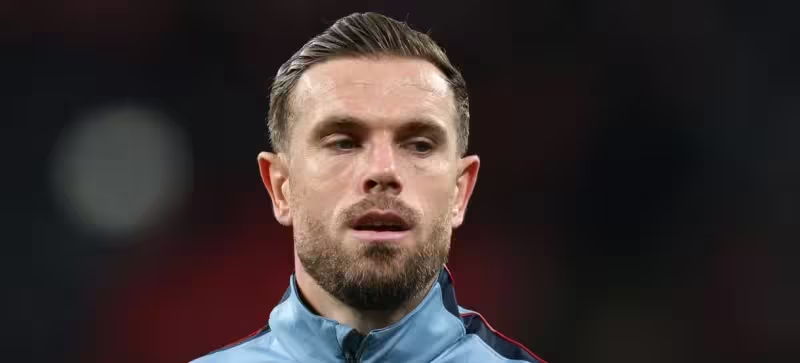
Jordan Henderson was named in England’s squad for the 2026 World Cup, a selection that makes the 35-year-old the first Englishman chosen for seven major international tournaments.
Thomas Tuchel included Henderson in his final group for the 2026 World Cup after recalling him to his first England squad in March 2025 for World Cup qualifiers against Albania and Latvia. The pick extends a tournament record that now lists Euro 2012, the 2014 World Cup, Euro 2016, the 2018 World Cup, Euro 2020, the 2022 World Cup and the 2026 World Cup.
The raw numbers underline why this matters. Henderson’s England career began in 2010 and now spans 15 years; he started in England’s 2018 World Cup semi-final defeat to Croatia and scored in England’s 3-0 round-of-16 win over Senegal at the 2022 World Cup in Qatar. At club level he played 492 times for Liverpool across 12 years and captained the club to the Premier League and the Champions League before leaving for Ajax and then joining Brentford on a free transfer in July 2025.
Henderson’s inclusion is also notable because he had been left out of Gareth Southgate’s squad for Euro 2024 — a high-profile omission that, at the time, seemed to mark a turning point in his international career. Tuchel’s decision to bring him back and keep him in the final World Cup group erases any simple narrative that Euro 2024 closed the door on the midfielder’s England story.
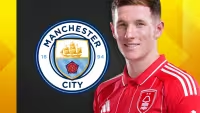


There is a clear tension in that reversal. Henderson is a veteran whose leadership and experience are indisputable; Tuchel has put him in the squad to carry those qualities into a tournament that begins for England on June 17 in Dallas against Croatia. But the selection does not answer how Tuchel plans to use him on the field. At 35, Henderson can no longer be presumed to be a regular starter purely on past form, and Tuchel’s final group contains midfield options whose roles have yet to be defined publicly.
Brentford’s staff and teammates have signalled support. Andrews, speaking about Henderson’s profile and career, said: "His professionalism is the best I’ve ever seen." Andrews added a personal note about Henderson’s place in English football: "Going back to Anfield will be quite special for him and pretty emotional. The part that he played in their history is hugely significant. I’ve no doubt he’ll get a brilliant reception." Those lines point to the symbolic weight Henderson carries — a bridge between a successful Liverpool era and a journeyman’s current club life at Brentford.
The schedule hands Henderson an immediate reminder of what is at stake. England begin their World Cup campaign against Croatia in Dallas on June 17, then face Panama in Boston and Ghana in New Jersey. Whether Tuchel deploys Henderson across minutes, uses him to steady the midfield from the bench, or leans on him primarily as a dressing-room leader will shape both England’s midfield texture and Henderson’s final international chapter.
This selection also cements Henderson’s place in English tournament history. No English player before him has been picked for seven major international tournaments, and that durability — from his first caps in 2010 through a club career that included 492 Liverpool appearances — is now official. It is a record that reframes the way his international career will be remembered.
For Henderson himself, the immediate next act is clear: join Tuchel’s travelling party, head to the United States and be part of England’s opening game in Dallas. As Andrews put it, the personal side — the return to venues tied to his past — will be "quite special" and, by extension, one of the defining images of England’s squad when the tournament unfolds.