



Apple is expected to unveil the iPhone 18 Pro and iPhone 18 Pro Max at its September iPhone launch, while the company may delay the regular iPhone 18 and an Air 2 model until the first half of 2027, according to reporting first published on 9to5mac.
Mark Gurman, who has covered Apple’s product cycles, has repeatedly described the iPhone 18 Pro as one that "won’t be a big update," yet the Pro lineup is still set to bring several notable hardware changes: a smaller Dynamic Island, the A20 Pro chip built on a 2‑nanometer process, and the new C2 5G modem with ultrawideband support arriving in the Pro models for the first time. The iPhone 18 Pro and iPhone 18 Pro Max are expected to deliver better performance and longer battery life as a result.
The numbers underlining why the release schedule matters are stark. Last year’s equivalent mass-market handset, the iPhone 17, started at $799; Apple has historically relied on a regular iPhone to anchor the roughly $1,000 price point in its lineup. If the equivalent iPhone 18 does not arrive until spring 2027, Apple could enter the fall without a fresh model at that critical threshold, leaving the Pro Max and, potentially, a soon‑to‑arrive Ultra as the only new premium choices.
The fall 2026 window is still expected to be busy. The iPhone 18 Pro Max — described in reporting as a 6.9‑inch smartphone — is set to ship in the fall and may briefly stand alone as Apple’s premium handset for a finite period if some launches slip. The iPhone Ultra, a first foldable Apple device described as a $2,000 product, is now expected to ship in late November, giving the iPhone 18 Pro Max a roughly 6‑8 week window as the top-of-line phone in the lineup.



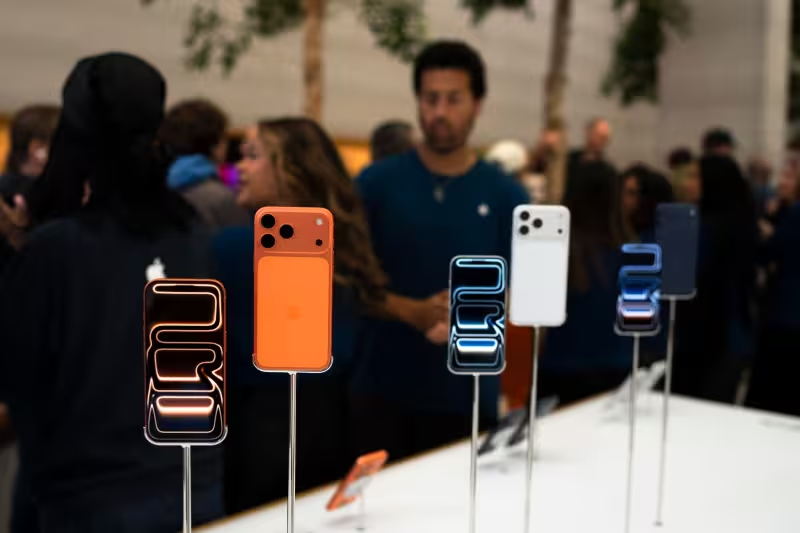
Design and camera changes are modest but specific. The iPhone 18 Pro is expected to come in a new Cherry Red color option, to reduce the Dynamic Island size, and to gain a main camera lens with a variable aperture and a slight change to the glass cutout on the back. Internals will reportedly be upgraded alongside those tweaks: the A20 Pro chip, based on 2‑nanometer technology, promises more efficiency, and the C2 modem should improve cellular features with built-in ultrawideband support.
Those upgrades create an awkward tension with the expectation that the Pro models "won’t be a big update." The phrase captures a broader pattern: for the past decade Apple’s fall hardware cycle has been predictable, with Pro models taking center stage. Yet the technical steps described — a 2‑nanometer A20 Pro, a new internal modem, camera variable aperture, and even the engineering required for an Ultra foldable — are precisely the kinds of changes that usually register as substantial on their own.
Timing and product mix introduce strategic tension as well. Pushing the base iPhone and an iPhone Air 2 into the first half of 2027 could help Apple stagger shipments around component availability and more testing, especially for the complex Ultra foldable. But it also risks a gap at the $1,000 breakpoint in fall 2026 and forces Apple to rely on the Pro Max and an expensive Ultra to carry holiday demand.
There are practical consequences for buyers and for Apple’s marketing: the Pro models are expected to ship with the C2 modem and upgraded A20 Pro chip, and the iPhone Ultra’s late‑November shipment date means some would‑be Ultra customers may wait much longer or pay a premium for the $2,000 device. The reporting also suggests Apple could introduce an upgraded iPhone 18e in 2027, arriving alongside the delayed iPhone 18 and Air 2 in the first half of that year.
Apple’s plan, as sketched in the reporting, reads as a deliberate prioritization of silicon and foldable engineering over a synchronized family launch. That implies a company willing to stagger availability to protect supply and refine new architectures, even if it leaves an opening at the mid‑to‑premium price band in time for the holiday season — a gap that could reshape purchase decisions this fall.