


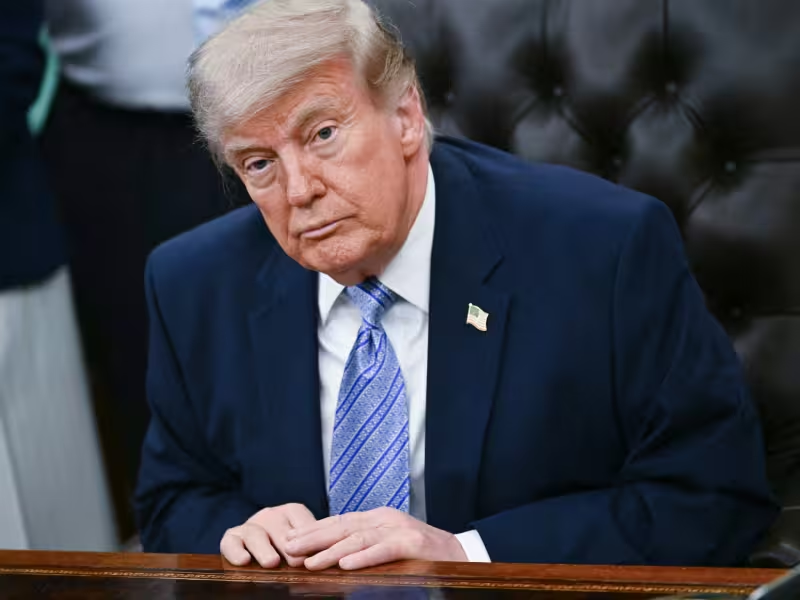
President Donald Trump said Saturday that "An agreement has been largely negotiated, subject to finalization between the United States of America, the Islamic Republic of Iran, and the various other Countries, as listed" and that the package would include reopening the Strait of Hormuz. He added that "Final aspects and details of the deal are currently being discussed, and will be announced shortly."
Trump framed a flurry of recent diplomacy as part of the push to finish the deal, saying he had a "very good call" with the leaders of Saudi Arabia, the United Arab Emirates, Qatar, and others about a "Memorandum of Understanding pertaining to PEACE," and that a Saturday call with Israeli Prime Minister Benjamin Netanyahu "went very well." He insisted any agreement would "absolutely" prevent Iran from obtaining a nuclear weapon.
Pakistan, which has been helping to negotiate as an intermediary, emerged on Saturday as the next potential host for talks. Prime Minister Shehbaz Sharif said of his phone contact with Trump, "I congratulate President Donald Trump on his extraordinary efforts to pursue peace," called the conversation "very useful and productive," and said, "We hope to host the next round of talks very soon," reflecting Pakistan's role in moving negotiations between Washington and Tehran.
Those talks follow a violent turn in late winter: the United States and Israel launched wide-ranging strikes on Iran on 28 February, Iran responded with attacks on Israel and U.S.-allied states in the Gulf, and a ceasefire was agreed in early April. Since that ceasefire, Washington and Tehran have been engaged in talks over a long-term peace deal, and Tehran's foreign ministry spokesman Esmaeil Baqaei said on Saturday that U.S. and Iranian positions "had been converging in the last week." Baqaei also described Iran's aim as an agreement "in the form of a framework, consisting of 14 points" and said further talks could be held within "30 to 60 days" with the possibility of ultimately reaching a final agreement.
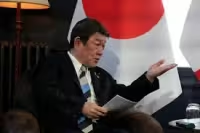
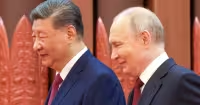
But the diplomacy sits on a fragile seam. Anonymous U.S. officials briefed U.S. media on Friday that the administration was preparing for a fresh round of military strikes, although no final decision had been made. That briefing came the same day Mr. Trump posted that he would not attend his son Donald Jr's wedding so he could remain in Washington, D.C., during what he called an important period of time.
Baqaei sharpened the contradiction on Saturday, warning that converging positions "did not mean agreements would be reached on key issues," and accusing the Americans of "contradictory statements." His caution undercuts the president's claim that an accord has been "largely negotiated" and sets up a narrow window in which words must be translated into signed commitments.
Two realities give this moment weight: the public claims of a near-complete deal and the clear signals that military options remain alive. Trump has repeated publicly that final details "will be announced shortly," while Pakistani and Iranian officials speak of a 14-point framework and a timetable measured in "30 to 60 days." That mix — a president promising a finished deal and officials quietly preparing for strikes — is the defining friction of the moment.
The central question now is straightforward: will the largely negotiated package Mr. Trump describes be finalized in the coming weeks, or will preparations for new strikes overtake the diplomacy? The answer will determine whether months of strikes, a ceasefire in early April and subsequent talks lead to a written framework and a pathway to a final deal, or whether the next chapter returns the region to open confrontation.