




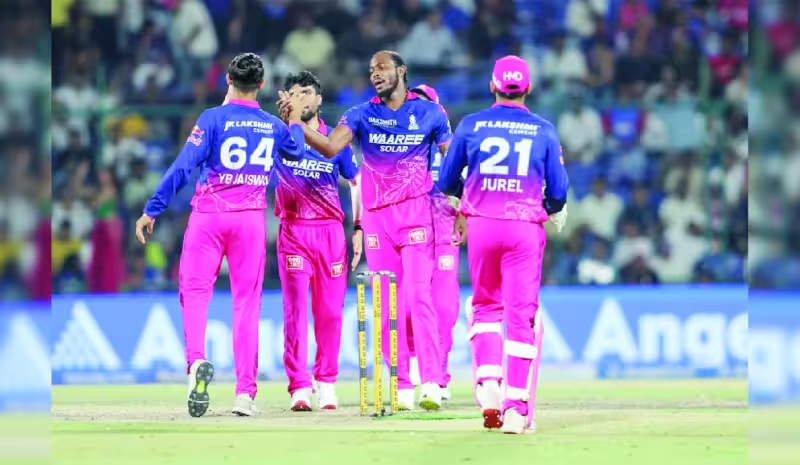
Rajasthan Royals took on Mumbai Indians on Sunday in a match that boiled down to one clear, immediate fact: a Royals win would lift them from 14 to 16 points and put tangible distance between them and two rivals still chasing the last playoff place.
For Rajasthan, that fight for a spot came with a single player front and center — Yashasvi Jaiswal. He has history at the venue — a maiden IPL century there three years ago, a second hundred the following year, and a blistering 32-ball 77 against Jasprit Bumrah and Co. in Guwahati — and the Royals’ hopes for momentum rested on his bat.
The arithmetic before the match made the stakes exact. Rajasthan Royals were fourth with 14 points; a victory would take them to 16 and move them at least one point clear of Punjab Kings and Kolkata Knight Riders. If the Royals lost, the path became narrow and contingent: they would need both Punjab Kings and Kolkata Knight Riders to lose their final matches to keep any chance of reaching the play-offs.
Those numbers sat against contrasting recent form. Rajasthan had lost more than they had won in their last five outings; Mumbai Indians arrived with three losses and two wins in their last five and were widely described as struggling. For Mumbai, the match was framed as a chance for a final, consoling performance in a season that had slipped away — Suryakumar Yadav, Hardik Pandya and Tilak Varma were all given a shot at one last impactful showing.
Context sharpened the picture: the Royals were chasing the final playoff slot, the venue’s small dimensions were expected to favour their batting, and the conditions were forecast to be hot and humid — the kind of day that can sap bowlers and reward quick scoring. Jasprit Bumrah, one of the few guaranteed strike options for Mumbai, was also closing an exhausting six months of white-ball cricket and likely to require a break once the season finished.
The friction inside that simple setup was where the match’s real drama lived. Rajasthan’s reliance on Jaiswal masked an uncomfortable truth — the Royals still needed more consistency from players like Riyan Parag and Dhruv Jurel. Their uneven returns over recent weeks meant that even with a small ground and a batter in form, the Royals could not treat qualification as settled. On the other side, Mumbai’s experienced names carried form and fitness questions of their own: a team described as struggling had handed its senior stars one last opportunity to salvage pride, even as Jasprit Bumrah contended with fatigue after an extended white-ball stretch.
That clash of variables — venue, form, workload and history — made the match more than a checkpoint on a table. It converted into a single, sharp contest: can a Royals side with a pedigree of high scores at this ground and a star in Jaiswal translate those advantages into a crucial two-point gain, or will Mumbai, playing with nothing to lose, snatch a consolation win and force Rajasthan into a dependence on other results?
The clearest answer the facts support is this: Rajasthan’s fate in the immediate term hinged less on spectacle and more on consistency. Jaiswal’s record at the venue gave the Royals a genuine edge, but without steadier output from Parag and Jurel they would remain vulnerable; a loss would hand their playoff hopes to the scoreboard elsewhere, requiring both Punjab Kings and Kolkata Knight Riders to stumble. For Mumbai, the match was a final opportunity for Suryakumar Yadav, Hardik Pandya and Tilak Varma to turn a disappointing sequence into a memorable last stand, while Bumrah’s impending rest after six months of white-ball work loomed as a reminder that the season was, for some, already winding down.
In the end the result the table demanded was simple: win and Rajasthan move toward certainty; lose and they hand their fate to others. And for a Royals side that has leaned on one man’s history at this ground, the question the day left behind was equally direct — can Yashasvi Jaiswal’s proven form carry his team past inconsistency and into the top four?