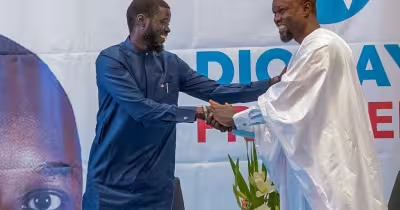





Romuald Wadagni was expected to take the presidential oath between 11:00 and 11:15 in the morning and then to deliver his inaugural speech about half an hour after the swearing-in, marking the formal start of the transfer of power that followed his April election with 94% of the vote.
Wadagni, 50 next month, arrives at the lectern as a figure known more for balance sheets than campaign rallies. He spent ten years in the political shadow of Patrice Talon and served as minister of Economy and Finance before running for the presidency. His résumé includes seventeen years at Deloitte, working in France, the United States and Africa, and training as an expert-comptable at the University of Grenoble — details that helped prompt one description of him as the architect of the new Beninese economy.
Those credentials framed both his vote tally and the expectations for his first public address. Elected in April with 94% of the vote, Wadagni was not affiliated with any political party during the campaign, a point his backers have pointed to as proof of a technocratic mandate rather than a partisan takeover. The oath and speech scheduled in the late morning were the final formal steps in a year in which he moved from long-time finance minister to head of state.
Analysts and acquaintances say the man who will speak following the oath is not the easiest person to size up. "De prime abord, il peut paraître froid et cassant, admet l’analyste politique Fiacre Vidjingninou. Mais une fois la glace brisée il est une personne normale," Vidjingninou said, a reminder that the public presentation at the inauguration may not capture the private, managerial instincts that have defined his career.
Context matters: Wadagni has been a long-time technocrat who stayed out of the media spotlight, and his rise to the presidency has been framed as the end of ten years under Patrice Talon’s political dominance. Talon came to power in 2016 and later sought out Wadagni, bringing him into the government and setting the stage for a decade in which social and financial reforms were prioritized by the executive branch. That history makes Wadagni’s inauguration less a rupture than the culmination of a policy arc that began when he joined Talon’s team.
The tension in this moment is straightforward and unavoidable. Wadagni’s career is built on technical mastery — auditing, finance, reform — and on service inside a government led by Talon for ten years. Yet he won an overwhelming personal mandate in April while running without party affiliation, a paradox that raises a central question about the nature of his authority. Is this a technocrat now entitled to independent political leadership, or is this the next step in a succession that preserves the policy imprint of the Talon years?
The detail that he worked for seventeen years at Deloitte in three continents, that Talon personally sought him in 2016, and that he was described as architect of a new economy, all feed into that contradiction. They suggest both continuity and competence. They also underline why the half-hour following the oath — the inaugural speech scheduled to follow the 11:00–11:15 swearing-in — will be scrutinized for tone as much as for policy specifics. Observers will listen for signals about personnel, economic priorities and whether the new president intends to broaden his political base or govern through technocratic means.
The single consequential question now is whether Romuald Wadagni will use the overwhelming vote and the ceremonial moment after the oath to assert independence from the decade he spent in Patrice Talon’s shadow or to entrench a managerial continuity that keeps the same economic course; his inaugural address, expected roughly half an hour after the swearing-in, will be the first clear answer.