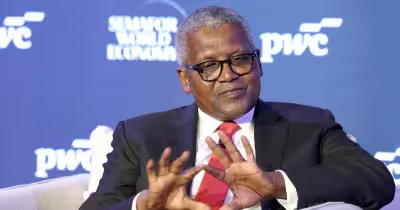




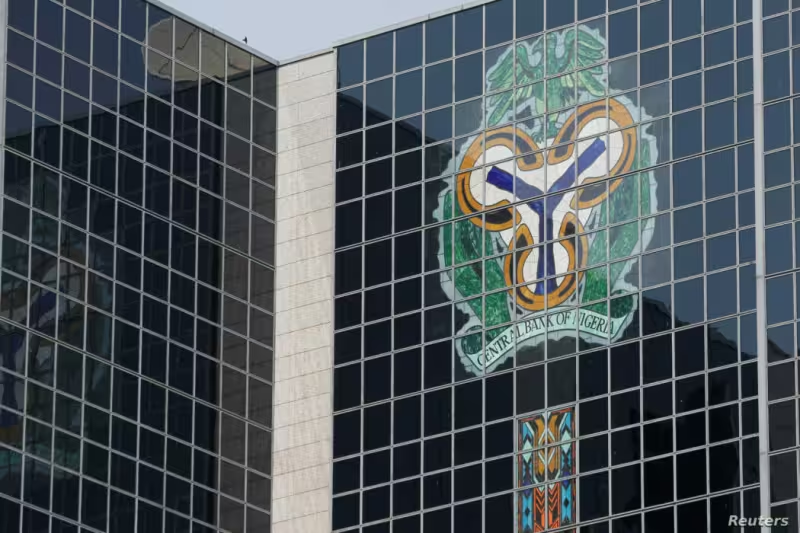
Olayemi Cardoso, governor of the Central Bank of Nigeria, told delegates at the opening session of the Monetary Policy Committee workshop in Abuja on May 21, 2026, that the bank has embarked on a deliberate return to conventional monetary policy and clearer communications. Cardoso opened the session under the workshop theme, "Strengthening Monetary Policy Effectiveness Towards Sustainable Macroeconomic Stability," and framed the reforms as central to restoring confidence in the Nigerian economy.
Cardoso delivered a blunt assessment of where the bank started and where it is headed. He said the CBN faced weakened institutional autonomy, reduced policy credibility, and reliance on unorthodox monetary tools at the inception of his administration, and that those structural weaknesses fuelled rising inflationary pressures, exchange-rate volatility, and erosion of investor and public confidence. He told the MPC workshop that those conditions required a marked change in approach.
On the change itself, Cardoso was explicit: "the CBN has restored a more orthodox approach to monetary policy under the current MPC framework, with renewed emphasis on conventional instruments and the policy rate as the primary signalling tool." He said conventional instruments and the policy rate are now front and centre, and that improvements in liquidity management, forward guidance, and policy communication have enhanced transparency. Those shifts, he said, support clearer signals to markets and a predictable framework for decision-making.


Cardoso balanced claims of progress with caution. He said exchange-rate stability has improved and that enhanced transparency in the foreign exchange market has supported more efficient price discovery and reduced volatility, while the economy’s growing resilience to external shocks is linked to ongoing reforms and improved policy coordination. He added that the Bank’s decision-making processes are increasingly anchored in data-driven analysis and structured deliberation, and that communication practices at the Bank have become more consistent and predictable.
At the same time, Cardoso reminded the workshop that the work is unfinished: "inflation, while still elevated and requiring close monitoring, has begun to moderate." That line framed the central tension of his remarks. The governor acknowledged progress but warned that inflation remains a present risk, that fiscal-monetary coordination must remain strong, and that earlier opacity in the foreign exchange market and years of unconventional tools left a credibility gap the bank must close.
Looking ahead, Cardoso set a clear medium-term goal: the Bank’s objective is to transition to a more explicit inflation-targeting framework. He said that objective "will require deeper institutional reforms, stronger collaboration, and sustained technical work," signalling that policy change will depend as much on legal and institutional shifts as on interest-rate decisions. The single most consequential question from the workshop is whether the reforms Cardoso described—clearer signalling, improved liquidity management and market transparency, and data-driven deliberation—will be sufficient to rebuild durable policy credibility and drive inflation down to more stable levels.