

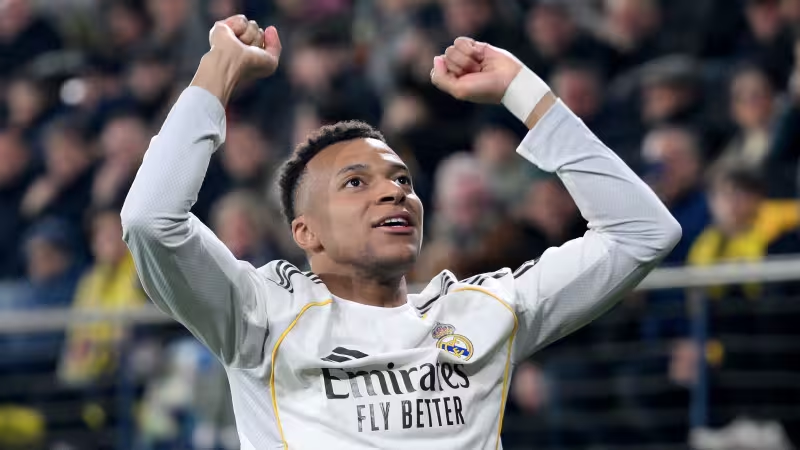
Kylian Mbappé clinched the Pichichi Trophy for a second consecutive season after finishing LaLiga with 25 goals in 31 matches, sealing the award with a goal in Real Madrid’s 4-2 final-day win over Athletic Club.
The tally left him ahead of Vedat Muriqi, who finished on 23 goals, and Ante Budimir, who ended with 17. Real Madrid underlined the milestone in a club statement: "Our forward, who finishes the league with 25 goals, wins this award for the second consecutive season."
Mbappé’s strike on the last day did more than decide an award; it closed out a two-season start at Real Madrid in which he has played 65 LaLiga matches and scored 56 goals. Season statistics also show he led the league in total shots with 63, a sign of how often he has been central to Madrid’s attack.
Those numbers matter because back-to-back Pichichi trophies are rare at the club. Real Madrid pointed out that only madridistas such as Di Stéfano, Puskas, Amancio, Hugo Sánchez and Cristiano Ronaldo have achieved consecutive Pichichi wins — placing Mbappé in a line of club greats by official reckoning.
Outside the club, commentators noted a wider significance: Mbappé became the first player not named Cristiano Ronaldo or Lionel Messi in 38 years to claim the Pichichi in back-to-back seasons. That comparison frames his 25-goal season not simply as a personal triumph but as a break from a long-standing duopoly at the very top of Spain’s scoring charts.

The facts also show a shift from last season. Mbappé won the 2024-25 Pichichi with 31 goals, and while he fell to 25 this term, his overall output across two seasons—56 in 65 league appearances—keeps him on an exceptional scoring trajectory for a new arrival at the club.
There is a tension at the center of the story. Mbappé’s drop from 31 goals to 25 came even as he led LaLiga in total shots, which suggests a mixture of persistent dominance and diminishing conversion. The league-leading 63 shots underline how much of Real Madrid’s offensive work runs through him, but the raw numbers invite questions about efficiency and support: is this a player converting fewer chances, or a team adjusting around him?
For Real Madrid, the award is both confirmation and challenge. It confirms they have secured a forward capable of the club’s most storied individual honors. It also raises the expectation that the club will provide the service and structure needed for Mbappé to convert his high volume of attempts into an even higher goal return.
Where this leaves the broader race for LaLiga scoring is straightforward: Mbappé finished the 2025-26 season alone at the top with 25 goals, Muriqi closed at 23 and Budimir at 17, and the final-day scoring helped make the difference. In the telling of Real Madrid’s season, those three numbers—25, 23 and 17—mark clear separation at the summit.
Mbappé’s consecutive Pichichi wins already secure him a place in Real Madrid’s record books and end a recent pattern dominated by two names. The conclusion is unavoidable: in just two LaLiga seasons at the club he has established a legacy that only a handful of Madrid forwards can claim, and the club now has to build around the player who has repeatedly carried the scoring burden.