



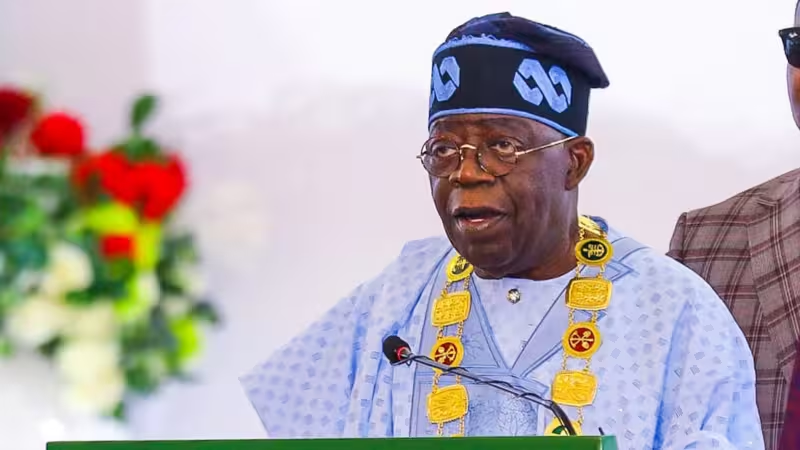
Kayode Are presented his Letter of Credence to U.S. President Donald Trump at the White House on Thursday, May 21.
Are stood among a group of envoys at the ceremony — one of twelve ambassadors who delivered credentials that day — after his posting to Washington was approved by President Bola Tinubu in January 2026 following Senate confirmation in December 2025.
The event was formal and routine in its pageantry: an honour guard provided by the armed forces, officers of the State Department and staff of the National Security Council all took part. Eleven other ambassadors presented letters alongside Are; the delegation included envoys from South Africa, Chad, Chile, Yemen, Australia and Kyrgyzstan.
Born in 1955, Are brings to the post a career built in uniform and in intelligence. He began his military journey at the Nigerian Defence Academy as a member of Regular Combatant Course 12 and was commissioned as a Second Lieutenant in December 1974. He earned a First Class Honours degree in Psychology from the University of Ibadan in 1980 and later completed a Master’s degree in International Law and Diplomacy at the University of Lagos in 1987.

Are served as an intelligence officer in the Directorate of Military Intelligence and rose to the rank of colonel before a compulsory retirement from the Nigerian Army in 1993. He was appointed Director General of the State Security Service in May 1999 and remained in that post until August 2007; he is described as the longest-serving director general in the agency’s history. The sources that compiled his record note more than three decades of experience in military intelligence and national security administration.
The dates attached to his recent confirmation underline how quickly the posting moved from nomination to credentialing in Washington. The Senate confirmed his nomination in December 2025; President Tinubu approved the posting in January 2026; by May 21 Are had formally assumed ambassadorial status before the U.S. president. That compressed sequence placed Are in the capital as part of a stable of new envoys arriving during the spring credentialing round.
There is a friction in the picture. A long career in military intelligence and domestic security contrasts with the day-to-day work diplomats perform in Washington. The ceremony’s diplomatic choreography — officers of the State Department, staff of the National Security Council and an armed forces honour guard — underscored that Are steps into a role that is as much about protocol and bilateral policy as it is about security experience. At the same time, he was one face among a dozen, which suggests his arrival is both notable for his resume and routine in the flow of international diplomacy.
The immediate facts are plain: Kayode Are has presented credentials, and his posting carries the formal endorsement of both the Nigerian Senate and President Tinubu. What remains to be seen — and what will shape how his appointment is judged here in Washington and in Abuja — is whether a career built in the Nigerian Army and the State Security Service will be deployed toward strengthening traditional diplomatic channels, toward security cooperation, or toward some blend of both.
How kayode are's three decades in military intelligence will translate into diplomacy in Washington is now the single consequential question his credentialed presence raises.