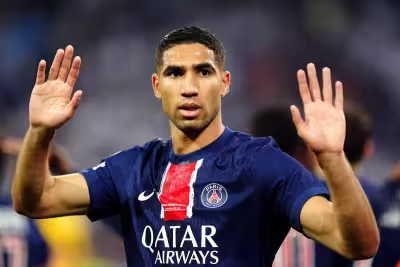





Enzo Fernandez stood on the sideline as Argentina clinched its place at the 2026 World Cup with five qualifying games to spare, sealing a campaign that finished nine points clear of Ecuador and guaranteeing the reigning champions will travel to North America under the heavy glare reserved for title-holders.
Fans typing "argentina fc" this week are not looking for transfer rumors — they are checking a deeper question: what squad will Lionel Scaloni take, and how will a side that has won a World Cup and a Copa America in quick succession cope with the expectations of defending a crown no nation has retained since 1962?
The case for concern and confidence sits in plain numbers. Argentina beat Brazil 4-1 during qualifying, finished nine points ahead of second-placed Ecuador and wrapped qualification extraordinarily early. Scaloni, who has led the national team since 2018, has already delivered two Copa America titles and the 2022 World Cup in Qatar, and could become only the second manager to win the World Cup twice if Argentina repeat in 2026. On the pitch, Fernandez has emerged as the creative heartbeat from midfield while Julian Alvarez and Lautaro Martinez supply goals; Emiliano Martinez has repeatedly produced decisive saves, a specialist in shootouts with 33 penalties faced in competitive shootouts and 10 saved (two others missed).



Still, the clean sheet on the résumé masks real friction. Lionel Messi will turn 39 during the tournament and will be playing his sixth World Cup — 26 matches, 13 goals and eight assists already in his record — but many observers describe him as being in relative decline, and Angel Di Maria has retired from international football, removing a long-time attacking option and locker-room voice. At the back, Cristian Romero’s injury problems and Nicolas Tagliafico’s difficult finish to the season at Lyon leave questions over centre-back and left-back stability that Argentina must resolve before Group J opens.
Those group opponents present a varied threat: Algeria, who won eight of 10 in qualifying and will test pace and resilience; Austria, a team capable of surprises and once recording a 10-0 qualifying win over San Marino; and Jordan, a World Cup debutant whose unfamiliarity could be dangerous in different ways. The mix matters because Argentina’s qualifying form showed they can dominate a long campaign, but knockout tournaments demand defensive consistency and fresh legs — roles Fernandez and a younger midfield core are expected to shoulder while Messi’s influence inevitably shifts.
Scaloni’s choices over the next months will crystallize the balance between experience and renewal. Will he build a side that protects an ageing Messi and masks defensive gaps with midfield control, or will he gamble on faster, less-proven combinations around Fernandez to chase another title? The tactical and personnel answers will determine whether the early, emphatic qualifying becomes the foundation for a historic back-to-back or only a prelude to a brave but failed defense.
The single, unavoidable question now: can Scaloni pick a team that lets Enzo Fernandez and a new generation cover for a waning Messi and repair defensive frailties well enough to win the World Cup again?