


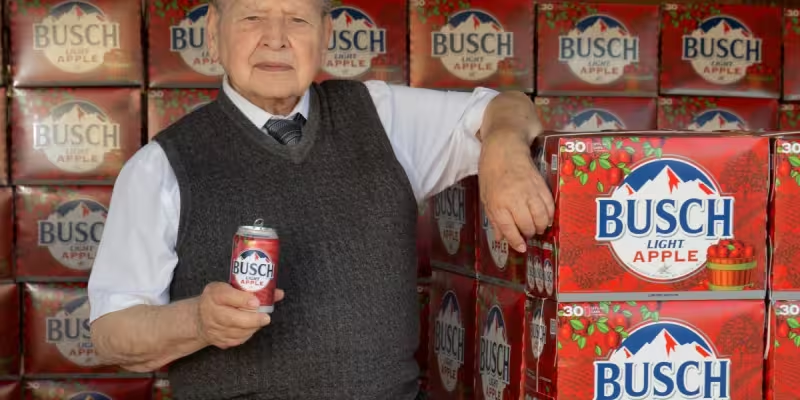
Ronald G. Wayne, who signed Apple’s original partnership agreement on April 1, 1976, has found himself back in the headlines after partnering this month with Anheuser-Busch to promote the return of Busch Light Apple.
Wayne, 91, is best known inside technology history as the third signature on the document that formally established the Apple Computer Company and for drafting that original partnership agreement. He received a 10% stake while Steve Jobs and Steve Wozniak each held 45%, but sold his share back for $800 and later accepted an additional $1,500 to formally forfeit any future claim to the company.
The numbers make the moment tangible. Apple’s market cap is described in recent coverage as hovering around about $4 trillion, and the 10% stake Wayne gave up could theoretically be worth more than $400 billion today. The contrast has fueled the what-if angle of his story: a brief, early role that has been magnified by a multitrillion-dollar corporate ascent.
Wayne said in an emailed statement to Fortune, "My success has never been defined by money," adding, "It’s been defined by acting with clarity, integrity, and sound judgment, given what I actually knew at the time." He has repeatedly framed his exit as a legal and practical judgment rather than a missed windfall.
The facts he points to are concrete. Apple in 1976 was a general partnership — which Wayne drafted — and that structure meant unlimited liability: "Understand exactly what you are agreeing to, particularly in a general partnership, where liability is not limited to your ownership percentage," he told Fortune. "Each partner can be held responsible for the full amount of any obligation." Wayne has been blunt about the practical counsel he would offer others: "Understand your risk in practice, not just on paper. Have counsel," he wrote. "And never assume your exposure ends at your percentage, because it doesn’t."
Wayne has said before that he was recruited from Atari by Jobs to help persuade Wozniak to commercialize his hobbyist designs. "They were in their 20s, and I had 20 years (of) experience in the field, so they could draw upon me for information they had no direct access to before," Wayne told PCMag. He designed Apple’s first logo, a detailed drawing of Isaac Newton under a tree, and helped shepherd the fledgling operation in its first days.
But the early company needed cash. Apple’s first major order required a $15,000 loan and the buyer had a questionable payment reputation, factors that intensified Wayne’s worry about being on the hook for debts. Wayne already owned a house, savings and other assets when he left, and he exited the partnership 12 days after it was founded.
That short tenure — 12 days between signing and exit — is the friction at the center of the story. On paper the decision looks like a lost fortune; in Wayne’s retelling it looks like risk avoidance. The tension sharpens with his recent promotional work: earlier this month he partnered with Anheuser-Busch to tout Busch Light Apple and even joked in a promotional video, "Let me show you where a man’s wealth really lies," while pointing to a garage full of beer, later adding, "Yep, still a really good investment." The stunt has reminded audiences that Wayne stepped away long before Apple’s value became imaginable.
That contrast — a man who walked away from a tiny slice of what became one of the most valuable companies in history, and who now lives quietly in Nevada largely removed from Silicon Valley — frames what matters right now. Wayne’s account is not a confession of regret so much as a lesson: he insists his choice was grounded in the liability he would have carried as a partner and in the limited information he had at the time.
The most consequential question left after revisiting this moment is not what Wayne could have had, but whether his warnings about partnership risk will carry weight in an era when many startups still form informal agreements around big ideas. For now, Wayne returns to the line he gave Fortune: "My success has never been defined by money," and to a private life in Nevada that, at 91, he seems content with — beer in a garage, a hand-drawn Newton logo in a drawer, and a clear memory of why he chose to walk away.