





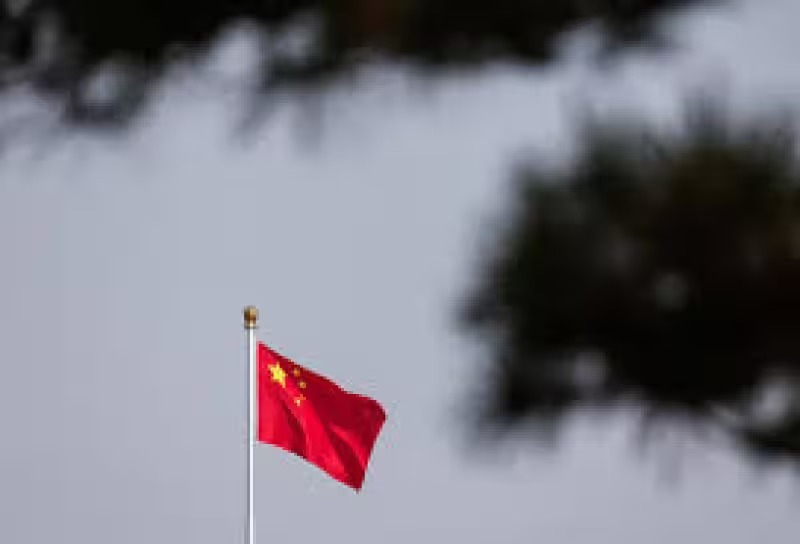
Taiwan President Lai Ching-te cancelled a trip to Eswatini after Seychelles, Mauritius and Madagascar revoked flight permits that would have allowed his plane to reach the African kingdom, Taipei said.
Lai had been due in Eswatini from 22 to 26 April to attend celebrations marking the 40th anniversary of King Mswati III's accession and the king's birthday, but Taiwan called off the visit after the three countries withdrew permission for his aircraft to pass through their airspace.
Taiwanese officials said the three African countries revoked the flight permits unexpectedly and without prior notice and that the move came after intense pressure and economic coercion from China. This is the first publicly known instance in which Taiwan's leader has had to cancel a trip because flight permits were revoked.
Eswatini, Taiwan's only diplomatic ally in Africa and one of Taiwan's 12 diplomatic partners worldwide, said it regretted Lai was unable to visit and that the cancellation would not change the status of its longstanding bilateral relationship with Taiwan.
Lai used the episode to underscore his government's posture toward Beijing. He said "No amount of threats or coercion will shake Taiwan's resolve to engage with the world," and Taiwan announced it will appoint a special envoy to attend the Eswatini celebrations on Lai's behalf.
Beijing denied any coercion and praised the three countries for their decisions. A spokesperson for the Taiwan Affairs Office of the State Council said Beijing "appreciated the position and actions of the relevant countries in upholding the one-China principle." China's Ministry of Foreign Affairs went further in rhetoric, saying "the so-called 'President of the Republic of China' no longer exists in the world." The Taiwan account and China's statements expose the sharp diplomatic tug-of-war over formal recognition and international space.
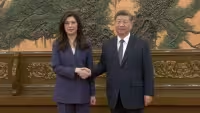
There is a further complication: Seychelles and Madagascar said they took the decision because they do not recognise Taiwan. That public position underscores the fragile status of Taipei's formal ties and the diplomatic choices small states face when Beijing exerts influence. Taiwan officials described the revocations as abrupt, amplifying concern in Taipei about how quickly access can be cut off.
The incident comes amid a broader escalation in Chinese military and diplomatic pressure around the island. Taipei has recently been tracking Chinese naval movements, including an aircraft carrier transiting the Taiwan Strait; officials monitored the passage closely during that operation (see China Deploys Chinese Aircraft Carrier Liaoning Through Taiwan Strait, Taipei Monitored — and Taipei Says Chinese Aircraft Carrier Sailed Through Taiwan Strait, Monitored —
Reaction in Washington was swift. The House Foreign Affairs Committee Majority said the three countries "stood with Taiwan against this blatant coercion." Separately, U.S. Senator Ted Cruz criticised Mauritius over the move. Those responses reflect how Taiwan's diplomatic losses reverberate beyond Taipei and Beijing.
The tension at the centre of the story is simple and consequential: Beijing publicly framed the airspace decisions as adherence to the one-China principle while Taipei said they were the result of pressure and economic coercion. That contradiction leaves smaller capitals caught between competing diplomatic orders and raises questions about the limits of Taiwan's ability to travel even when it retains formal ties.
For now, the immediate outcome is procedural: a special envoy will attend Eswatini's anniversary and birthday events in Lai's stead, and Eswatini has said its relationship with Taiwan remains unchanged. But the broader consequence is political: this episode, the first time a Taiwanese president has cancelled a trip for this reason, demonstrates how Beijing's reach can alter the calendar of diplomatic engagement and will likely shape Taipei's planning for future visits.