





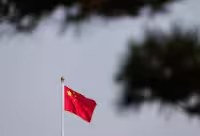
Taipei said a Chinese aircraft carrier sailed through the Taiwan Strait on Friday and was closely monitored by Taipei’s authorities (claimed by Taipei). Beijing’s defence spokesperson Zhang Xiaogang told a Friday briefing that "Taiwan independence" is the root cause of tension and rejected criticism of People’s Liberation Army drills around Taiwan (claimed by Zhang Xiaogang).
Taipei: Carrier Transit Monitored
Taipei reported the transit as a discrete movement that island authorities tracked in real time; Taipei framed the monitoring as routine surveillance of Chinese naval movements (claimed by Taipei). The carrier transit occurred the same week Beijing’s public statements blamed U.S. contacts and local policy for rising tensions, a framing Taipei and China dispute on opposite terms.
China Ministry of National Defense
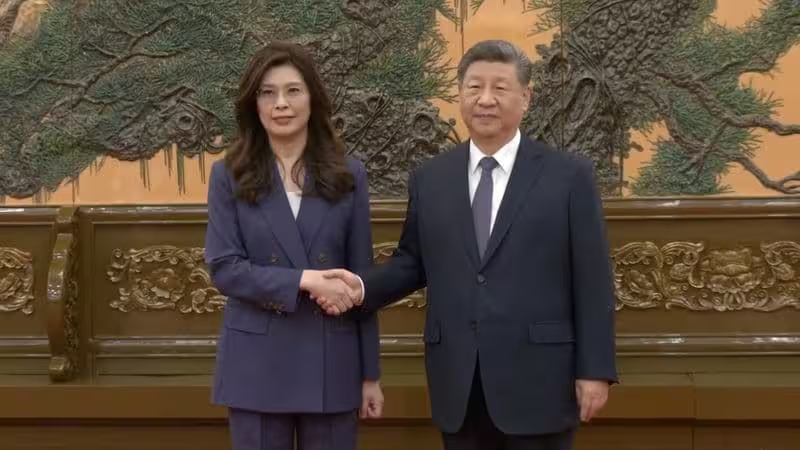
Zhang Xiaogang said PLA drills and training around Taiwan Island were "completely legitimate, reasonable, and entirely justified" and rejected characterisations of pressure or coercion (claimed by Zhang Xiaogang). Zhang accused the Democratic Progressive Party authorities of "distorting and hyping PLA actions" and of "peddling war anxiety" to the island’s residents (claimed by Zhang Xiaogang). At the same Friday briefing Zhang also said visits by several U.S. Congress members to Taiwan included calls to fast-track a "special defense budget" and that "there is no such thing as a "defense budget" for Taiwan because Taiwan is part of China" (claimed by Zhang Xiaogang).
Taiwan Affairs Office Statement
On April 15, 2026, China’s Taiwan Affairs Office said U.S. claims of Chinese military pressure on Taiwan were "a distortion," and spokesperson Chen Binhua called those U.S. claims "a complete distortion of the facts" that "harbours malicious intentions" (claimed by Chen Binhua). That April 15 statement followed China’s stepped-up military activity, including rounds of war games and live-fire drills China held in late December (confirmed).
The human centre of Beijing’s critique is Taiwan leader Lai Ching-te. Zhang accused Lai of expressing gratitude while advocating military cooperation with the United States and said Taipei was "using the Taiwan people’s money to pledge allegiance to the United States for the selfish purpose of seeking "Taiwan independence"" (claimed by Zhang Xiaogang). Lai Ching-te is thus central to the competing narratives: Taipei’s monitoring of the carrier transit is presented locally as defensive tracking, while Beijing ties his posture to broader security cooperation with the United States.
The friction point is clear and concrete: Taipei says it tracked a Chinese aircraft carrier transiting the Taiwan Strait; Beijing says its drills are justified and that Taipei and visiting U.S. lawmakers are inflating threat perceptions (claimed by Taipei; claimed by Zhang Xiaogang). That contradiction—monitored movement versus a Chinese narrative of legitimate training and accusations of distortion—drives the diplomatic dispute between Taiwan, China and, by proxy, visiting U.S. lawmakers.
Which policy choice comes next is the immediate open question: will Taipei move to accelerate the "special defense budget" measures that Zhang says visiting U.S. Congress members urged, or will Taipei treat the carrier transit as a routine security incident confined to monitoring and public admonitions? The answer will determine whether the island shifts budgetary policy, a tangible change for residents and for Lai Ching-te’s government, or whether the episode stays framed as competing claims over military signalling (claimed by Zhang Xiaogang; claimed by Chen Binhua; claimed by Taipei).