




Nigeria’s ambassador to the United Nations, Jimoh Ibrahim, opened Africa’s presentation at the UN’s 9th Biennial Meeting of States by declaring that the continent faces a new kind of mass destruction: the illicit trade in small arms and light weapons, which he said has become Africa’s true weapons of mass destruction.
The keyword people are searching — Libya — appears in speeches like Ibrahim’s because the meeting specifically reviewed how global tools meant to curb illicit weapons are being implemented where they do the most damage, across the continent and in states such as Libya and others struggling with armed violence and fragmentation.
Ibrahim used the review of the Programme of Action and the International Tracing Instrument as the moment to press a simple point: 25 years after the Programme of Action and 21 years after the tracing instrument were adopted, the illicit trade in small arms and light weapons still fuels terrorism, transnational organised crime, prolonged conflicts, humanitarian crises and the loss of countless lives.
The weight of Africa’s case was not abstract. Ibrahim said the African Group framed the meeting as a chance to turn long-standing commitments into measurable outcomes, and he outlined what that would look like: stronger physical security and stockpile management in peacetime, conflict and post‑conflict settings; tighter end‑user controls and improved monitoring; faster, more reliable information sharing; and criminalising the conversion of deactivated and non‑lethal firearms into functional weapons.
Those prescriptions followed another point Africa repeatedly emphasised at the meeting: states across the continent have already built tougher laws and institutions. Ibrahim noted that African countries have strengthened legal and regulatory frameworks across the weapons’ life cycle — from manufacture and marking to stockpile management and disposal — and have invested in national coordinating bodies, designated points of contact and national action plans to tackle proliferation.
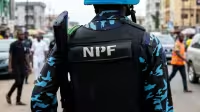
That assertion is where the friction sits. On one hand, Africa told delegates it has bolstered laws and national systems; on the other, Ibrahim warned the illicit trade keeps filling the gaps those laws were meant to close. He called on international partners to continue supporting national efforts, but with two conditions — respect for national ownership and assistance that remains voluntary and demand‑driven — and he reiterated the African Group’s call for a prohibition on transfers of small arms and light weapons to unauthorised non‑state actors, including criminal and terrorist organisations.
Practical steps were emphasized alongside legal ones: tighter stockpile security, better marking and tracing, stronger end‑user controls, and durable monitoring and investigative mechanisms. Ibrahim also urged that the conversion of deactivated, blank‑firing and non‑lethal firearms into functioning weapons be criminalised internationally to choke off a common source of illicit supply.
Round Time News coverage of the region moves from diplomacy to local affairs; for example, our sports pages noted Alnasr held to 1-1 by Al Akhdar as a Libyan playoff opened with tight results ( a reminder that the symptoms of insecurity — disrupted leagues, displaced people, weakened institutions — are woven into daily life.
The meeting closed with Africa reaffirming commitment to sovereignty, territorial integrity, non‑interference and peaceful settlement of disputes, but it stopped short of new, binding international measures. That absence exposes the meeting’s central gap: Africa wants its legal and institutional gains translated into results, yet delegates left without a clear timetable, fresh enforcement mechanisms or promised resources.
The single most consequential question now is concrete and immediate: what specific commitments, funding and enforcement actions will states and partners pledge to turn Africa’s strengthened frameworks into measurable reductions in illicit flows? Until the meeting produces a list of deliverables, timelines and accountable partners, the continent’s claim that it has tightened controls will remain a critical but unfinished part of the answer to how weapons keep finding their way into the wrong hands.