




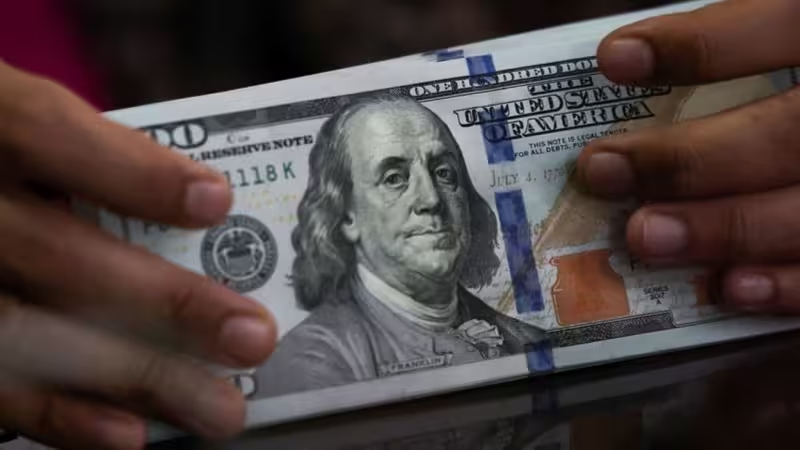
The naira firmed against the dollar on Monday, May 25, 2026, with the official rate moving to N1,374.91 per dollar and the parallel market quoted at N1,395 per dollar.
Data from the Central Bank of Nigeria showed the official rate fell from N1,375.46 on Friday, May 22, 2026, a modest gain of 0.53 percent on the headline figure, while the black market rate improved by N5 to N1,395 on Monday.
The movements arrive against a backdrop of gradual stabilization in the foreign exchange market: Nigeria’s foreign reserves remained at $48.98 billion as of May 22, 2026, and April recorded an outright appreciation of the naira, which strengthened by 1.42 per cent for the month.
In April the naira gained N19.67 to close at an average spot rate of N1,361.51 per dollar, after averaging N1,381.18 per dollar in March. Market trading ranges narrowed in April — the currency traded between N1,341.01 and N1,389 per dollar — compared with a wider band in March of N1,345.00 to N1,425 per dollar.
The Central Bank intensified liquidity management in April, issuing open market operation bills totalling N9.71 trillion, a 27.37 per cent rise from N7.62 trillion issued in March 2026, as the authority sought to absorb excess naira and steady the exchange rate.



Those policy moves appear to be working at the margins: the official market showed a small but measurable strengthening on Monday relative to late last week, and the black market quoted a firmer level after a N5 move. The April figures — a month in which the naira posted a 1.42 per cent gain and closed at an average N1,361.51 — give further weight to the claim of improving stability.
At the same time, the contrast between official and parallel quotes remains notable. The official N1,374.91 per dollar sits roughly N20 above the black market N1,395 per dollar, and the persistent gap underscores a market still split between regulated flows and informal liquidity.
There is an apparent tension between reduced volatility in April and the shorter-term swings seen around the May 22–25 window: the primary note on recent trading shows the naira had dropped on Friday last week before rebounding on Monday, May 25. That rebound was modest at the official window but mirrored by a N5 improvement in the black market, suggesting uneven transmission of policy effects across trading venues.
Policy activity has been heavy. The Central Bank’s OMO bill sales of N9.71 trillion in April were a clear escalation in liquidity management, and they followed a month when the naira’s trading range tightened and the spot average improved by nearly N20. Yet foreign reserves held steady at $48.98 billion as of May 22, leaving the central bank’s external buffer unchanged while it leaned on domestic instruments to influence the naira to dollar dynamics.
The most consequential question now is whether the central bank’s mix of liquidity absorption through OMO bills and a steady reserves position will be sufficient to sustain the official gains and narrow the split with the parallel market. The April numbers show policy can coincide with improved stability, but the jumpy trading late in May highlights how fragile those gains can be if flows or sentiment shift.