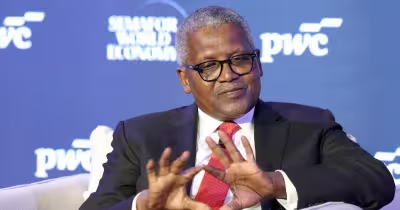




Niyi Adeseun led Tatum Bank’s board and management on a courtesy visit to Lagos State Governor Babajide Sanwo-Olu to discuss partnership opportunities and the bank’s role in the state’s financial services ecosystem.
The meeting came after a string of early financial milestones for Tatum. The bank, which commenced operations in May 2025, reported a Profit Before Tax of N1.7 billion after eight months of the 2025 financial year and met the Central Bank of Nigeria’s recapitalization milestone within approximately ten months of starting operations. Tatum has also begun collaborating with the DAP Experience Centre and provided payment gateway infrastructure for the centre’s 'I Love Lagos' initiative.
Adeseun framed the visit as part of a wider effort to embed the new bank in Lagos’s economy, saying the institution aimed to position Tatum as "a safe haven" for customers and partners as it scaled its services. He and his team outlined concrete areas for cooperation that would tie the bank’s payment and gateway work with public‑facing projects already underway in the city.
Sanwo-Olu welcomed the delegation, praising Lagos’s economic clout and urging deeper links between government and private finance. The governor said Lagos remains the largest sub-national economy in Africa and the economic nerve centre of Nigeria, and he stressed the need for supporting businesses and fostering partnerships that deepen financial inclusion and economic prosperity.
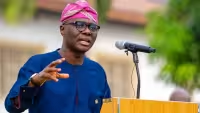
Officials described the meeting as an introduction of the young bank to state government leaders and an opening salvo in negotiations over how municipal projects and private payment infrastructure might be coordinated. Tatum’s recent work with the DAP Experience Centre — supplying the payment gateway for the 'I Love Lagos' initiative — was presented as an example of the sort of public‑private link the bank hopes to expand.
The rapid pace of Tatum’s early results supplies both momentum and a test. The bank only began operations in May 2025, yet it cleared the CBN recapitalization milestone in roughly ten months and recorded N1.7 billion PBT after eight months of the 2025 financial year. Those figures give the bank credibility at the table, but they also raise the practical question of whether a young lender can convert early profit and technical wins into stable, long‑term partnerships with a sprawling state government.
That question matters to Lagos now because the governor framed the visit as part of a push to marshal private finance behind initiatives that broaden access to services and commerce. If Tatum’s payment infrastructure for the DAP Experience Centre proves durable and scalable, the bank could win further municipal work; if not, its early financial headline numbers will mean less in the face of delivery challenges on public projects.
The entry of Tatum into Lagos’s financial landscape places it among established names already operating in Nigeria’s banking sector, including household institutions such as Union Bank Of Nigeria, and it leaves a clear pathway for what comes next: securing pilots and contracts that convert technology demonstrations into recurring revenue and measurable public outcomes. For Adeseun and his board, the immediate task is to translate the courtesy visit into memoranda of understanding and pilot agreements that tie Tatum’s gateway and payment capabilities to specific state programs.
Put plainly, Tatum has shown it can win regulatory milestones and early profit; the harder proof will be sustaining that performance through the slower, messier work of municipal partnerships. How quickly the bank turns the governor’s welcome and the DAP collaboration into lasting contracts will determine whether its early gains amount to a durable foothold in Lagos’s economy.