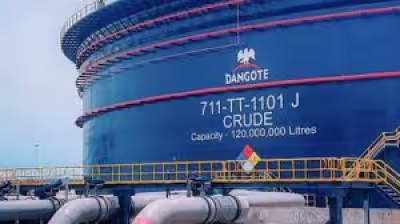




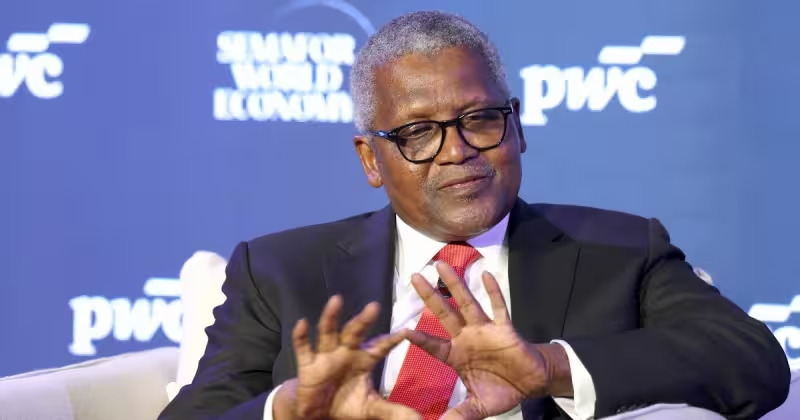
Dangote Petroleum Refinery filed a fresh lawsuit this month against the Federal Government of Nigeria and the Nigerian Midstream and Downstream Petroleum Regulatory Authority seeking to overturn import permits the regulator granted or renewed, saying the approvals violate an earlier court order directing parties to maintain the status quo.
The move follows a string of legal and regulatory clashes between the refinery and state-linked players after Dangote last July withdrew a N100 billion suit that accused regulators of continuing to issue import licences for Automotive Gas Oil and Jet A1 aviation fuel despite local refining capacity.
The weight of the dispute is numeric and immediate: Dangote’s refinery is a $20 billion facility with a stated capacity of 650,000 barrels per day, and the regulator recently issued licences to six companies to import 720,000 metric tonnes of premium motor spirit. Those licences, the new lawsuit says, cut across the court’s earlier instruction and threaten the refinery’s ability to displace imports.
NNPC Ltd has accused Dangote Petroleum Refinery of seeking to restrict competition and expose the country’s fuel market to monopoly control, arguing in court that granting Dangote’s request would threaten supply security and undermine market competition. The state company also told judges there was no "credible, independent or verifiable evidence" to support Dangote’s claims that continued imports were unnecessary.
Regulators have defended their actions by pointing to the Petroleum Industry Act, which the NNPC says allows import licences to be issued to companies that either have local refining capacity or have proven track records in international crude and petroleum-product trading. That legal line is now the hinge of the case: whether local refining capacity alone bars import licences when the regulator judges imports necessary for supply.


Context sharpens the stakes. Nigeria has long depended on imported petroleum products because decades of underperforming state-owned refineries left domestic output well below demand. The Federal Executive Council approved major spending in 2021—$1.5 billion for Port Harcourt, $897.6 million for Warri and $740.7 million for Kaduna refineries—yet those plants have still failed to produce a meaningful drop in import reliance. NNPC’s refineries at Port Harcourt and Warri have consumed more than $2.4 billion in public funds without delivering sustained domestic supply gains.
The dispute comes as Dangote gradually ramps up production and distribution capacity and as it prepares for a planned public listing. The company rejected efforts by NNPC to increase its stake in the refinery ahead of that listing, a fight over ownership and market influence that has fed mistrust between the parties.
Tension runs through the competing public arguments. Dangote says regulator approvals of new import permits ignore a court-ordered freeze and would nullify the commercial logic of investing in the nation’s first large-scale private refinery. Regulators and fuel marketers counter that licences and imports are still needed to guarantee adequate supply and prevent shortages while the market transitions; the recent issuance of licences to import 720,000 metric tonnes to six companies underscores that commercial calculation.
The legal conflict will now shift to the courts, where judges must decide whether the regulator’s recent actions actually breach the earlier order and whether Dangote’s claim to have local capacity should automatically bar imports. The answer will determine not only who can sell fuel next season but whether a privately built refinery can reshape a market long propped up by imports and state decisions.
For policy and markets, the central unresolved question is this: will the judiciary enforce the status-quo restrictions that Dangote says were breached, effectively limiting import licences where local refining exists, or will it endorse the regulator’s discretion to permit imports in the name of supply security? That ruling will redraw the boundary between private refinery capacity and regulatory power in Nigeria’s fuel market.