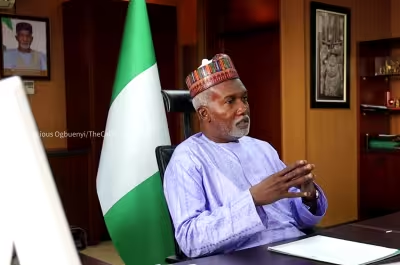



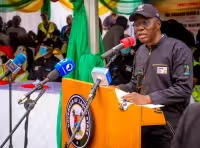

President Bassirou Diomaye Faye dismissed Prime Minister Ousmane Sonko and dissolved his government on Friday evening, removing the man who helped bring him to power and plunging Senegal into fresh political uncertainty.
Ousmane Sonko, 51 years old and the founder of the Parti des Patriotes africains du Sénégal pour le travail, l'éthique et la fraternité (PASTEF), had been appointed prime minister after Mr. Faye won the presidency. Sonko posted on Facebook after his dismissal, "Alhamdoulillah. Ce soir, je dormirai le cœur léger à la cité Keur Gorgui."
Sonko had been prevented from running in the 2024 presidential election after a defamation conviction cost him his civic rights, and he subsequently designated Bassirou Diomaye Faye as the PASTEF candidate. That sequence — Sonko blocked from the ballot, Sonko naming Faye, and Faye appointing Sonko as prime minister — made the two men the central figures in the movement that swept them into office.
Observers warned the dismissal and the dissolution of the government risk worsening uncertainty at a fraught moment for the country. Senegal is already facing a debt crisis and has been in prolonged negotiations with the International Monetary Fund, and analysts say a sudden rupture at the head of government complicates those talks.

The split between Mr. Faye and Mr. Sonko had been visible for months. Tensions between the president and his prime minister continued to rise after the election, even though Sonko’s significant influence was crucial to the ticket’s victory. That contradiction — Sonko’s outsized role in delivering power and his abrupt removal from office — is the central friction of the moment.
Sonko’s political rise was shaped before he joined the government: he had been an outspoken opponent of former President Macky Sall and energized youth support with pan-Africanist rhetoric. His conviction for defamation, which led to the loss of his civic rights and barred him from standing in 2024, remains a pivotal element in the recent political realignments that put Bassirou Diomaye Faye into the presidency.
The dismissal by bassirou diomaye faye on Friday evening closed a chapter that began when Sonko, after being blocked from the ballot, chose Faye as PASTEF’s candidate. After the election, Faye returned the favor by naming Sonko prime minister, a partnership that now lies dissolved.
The immediate consequences are practical as well as political: dissolving a government interrupts day-to-day governance at a moment when creditors and the IMF expect continuity and clear negotiating counterparts. Observers say that uncertainty — political and economic — is likely to increase in the short term as Senegal navigates its debt crisis and ongoing talks with the IMF.
The most consequential question now is whether Mr. Faye will move quickly to install a new cabinet capable of reassuring both domestic constituencies and international creditors; without that, the dismissal risks deepening the same uncertainty observers have already warned about.