




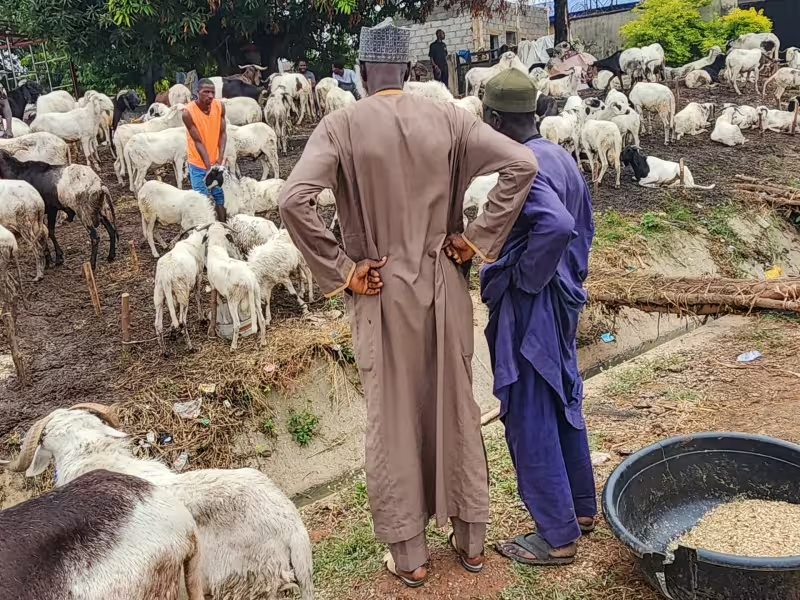
Yunus Akanji will not make the trip to Saki this Eid al-Adha. Instead, the Nigerian father bought a ram, stayed home with his wife, children and students, and said he would celebrate with whatever he has as the cost-of-living crisis keeps pushing up the price of even the most basic holiday plans.
For Akanji, the decision was part sacrifice and part arithmetic. Families across Nigeria are trimming Sallah spending as transport, food and other costs rise, and he is no exception. Eid al-Adha, known locally as Sallah, is normally marked with communal prayers and the ritual sacrifice of animals, but this year many households are approaching it with smaller budgets and lower expectations.
Nafisa Ibrahim made a similar calculation. She dropped plans to travel home for the holiday after finding that transport to Abuja had climbed to 35,000 naira, or about $26, up from the 15,000 naira, or about $11, she paid in February. The jump was enough to change her holiday plans entirely, leaving her in the city rather than on the road ahead of the celebration.
The squeeze is showing up in the markets as well. A few days before Sallah, Mile 12 Market was busy, but shoppers were buying less. Rukayat Bello said she cut back after checking tomato prices, counting out the cost before deciding she could not afford the quantity she had planned. “One, two, three, four…,” she said as she looked over the produce, before adding that she could not believe five pieces of tomatoes now cost 1,000 naira. She said she once bought baskets during festive periods without thinking much about it, but now everything was too expensive and her family was “just managing to cook what we can afford.”
Esther Inyang was making the same adjustments with food for her children. She said she mixed fresh tomatoes and peppers with cheaper, partially spoiled ones to reduce costs and cut the amount she planned to cook for Sallah. “I intended to cook well for my children during this Sallah, but had to reduce the quantity because tomatoes alone consumed most of my budget,” she said. She added that buying tomatoes and peppers now feels like buying gold, and that 3,000 naira used to be enough to prepare a decent pot of stew for her family, but no longer is.
Traders are feeling the strain too. Opeyemi Ibrahim said customer patronage has dropped sharply ahead of the festivities, while rising fuel costs and erratic electricity supply have driven up his expenses. “When there is no electricity, we have to run the generator,” he said. “Filling it costs about 10,000 naira.”
The pressure on households is part of a wider strain running through Nigeria’s economy, where food, transport, fuel and power costs have climbed together. In a separate market survey reported by Punch Newspapers, a small plate of about five tomatoes sold for between 500 naira and 1,000 naira, while a paint bucket of tomatoes fetched as much as 10,000 naira to 15,000 naira. For families trying to observe a major religious holiday with dignity, the message is plain: the celebration will happen, but on much tighter terms than before.
That is why Akanji’s decision lands beyond one household. When people begin scaling Eid back to what they can afford, the holiday is no longer a question of tradition alone. It is a measure of how far the cost-of-living crisis has reached into daily life, and this year it is reaching all the way to the Sallah table.