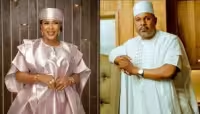





Jim Iyke told an interviewer that his marriage ended after he became completely consumed by fatherhood during a difficult period in his life and that he and his wife parted on friendly terms.
Speaking with Chude Jideonwo, Iyke described a personal collapse that shifted him from partner to protector of his child: "I lost my spark, and my wife suffered for it. Then I became an obsessive dad. I gave everything in me to my son. I was a proper stay-at-home dad." He added plainly, "I became an excellent father but a woeful husband."
Iyke said the change was profound and visible to his spouse. "I lost my spark I lost the lion and leader in me, and my wife suffered for it," he told Jideonwo, and later acknowledged, "I can’t find the man I married anymore." Confronted with that void, he said he told his wife he did not know what it would take to heal or how long recovery would take, and that he asked her to wait if she wanted to.
The clearest moment of the interview came when Iyke described his wife's decision. She told him she could not wait. "We shook hands and parted as friends," he said, framing the end of their marriage not as acrimony but as an agreed separation prompted by a gap neither could bridge at that moment.


This account matters today because it recasts a familiar celebrity storyline as a personal reckoning about parenthood and identity rather than a public scandal. Instead of allegations or a sudden split, Iyke presented a timeline in which intense devotion to his child and a concurrent emotional dimming at home produced the rupture. That framing is central to his telling: the marriage collapsed because the man he became as a father was not the man his wife had married.
The tension in Iyke's story is plain and intimate. He says he became the kind of father many would admire—"a proper stay-at-home dad" who "gave everything in me to my son"—but that the tradeoff was a failing marriage. He wanted time and could not promise a timetable for recovery; his wife wanted a partner now. Her refusal to wait is the fact that both explains and prevents reconciliation in the near term.
In the same interview, Iyke did not outline a path back to the marriage. He acknowledged the loss and described his own sense of being changed: an absence of the "lion and leader" he once was and the daily work he must do to find himself again. At the same time, he emphasized the human choice at the end: they parted "as friends," a fragile resolution that preserves dignity but closes the door on the immediate return to what they had.
The conclusion the facts support is straightforward: the marriage ended because Iyke's intense focus on fatherhood coincided with an emotional withdrawal that his wife could not endure, and when he asked for time to heal she chose not to wait. There is no claim of an active reconciliation; what remains, by his own account, is a man who must rebuild himself while continuing as the father he says he became.