




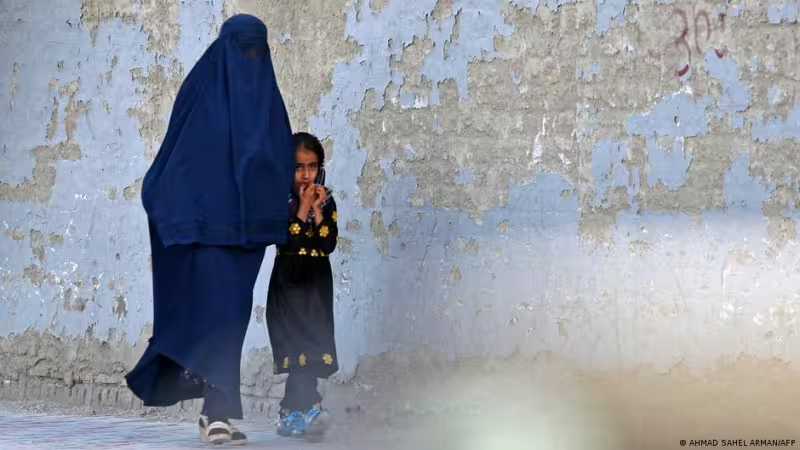
Alia, 19, travelled hundreds of miles from her village to Kabul last year to escape marriage, arriving by taxi with her female cousin with only their eyes visible.
"I made up an excuse to my family saying I was coming here to meet my friends and former classmates. But that's not true. They are not here. The actual reason is that if I stayed in Daykundi, I would be forced to get married," she said.
The scale of what Alia fled is immediate: the Taliban stopped girls over 12 going to school almost five years ago, leaving millions of girls in afghanistan with just one choice — marriage — and driving many families to view marriage as the only route to security in a country where three in four people cannot meet basic needs, the United Nations says.
Alia enrolled in an English language course after arriving in Kabul. Short-term private courses and madrasas are now the only options for girls to learn past primary school, and private tuition is available only to those who can afford it, not a substitute for formal schooling.
Her parents once encouraged a different path. "Before the ban, my parents passionately encouraged me to go to school. They told me you can definitely achieve your dream of becoming a pilot," Alia said. Now, she said, they press the opposite. "But now they say the best way for me is to get married because I can't go to school, to university, I can't even work."



Alia has been receiving marriage proposals since she left. She was not stopped at any Taliban checkpoints on the trip to Kabul, despite rules and Taliban inspectors who enforce bans on women travelling long distances without a male relative escorting them — an inconsistency that marks how the restrictions are applied unevenly across the country.
That inconsistency matters because it does not erase the pressure at home. Shama, another young woman from the same province, said she was pushed by her mother to get married four years ago when she was 18. "If the Taliban had not taken over, I would have almost finished school by now. I would be close to my dream of becoming a doctor. That is what I wanted," she said. Today Shama is the mother of an infant and a toddler; both of her children are girls.
The tension between aspiration and enforced choice runs through both stories. Families that once saw education as a route to professions — pilot, doctor — now see marriage as the safest option when schooling and work are closed off. Alia described how some households tighten control: "Some families can be very restrictive. It's possible they could tell me to forget my dreams. I don't feel positive at all about it."
For those who manage to leave their villages, the costs are real. Short-term private courses and madrasas can provide learning past primary school for a few, but those paths are limited, episodic and often unaffordable — leaving most girls with no institutional route to higher education, qualifications or work.
Alia says she will resist if her family tries to force her into marriage. "If my family don't force me to get married, I will wait. I will resist it until my very last breath," she said, and she continues to study English in Kabul while proposals arrive and family pressure builds.
Her choice — exile to the capital and a course that costs money and brings fragile safety — is the clearest available option for a young woman denied formal schooling. What comes next for Alia will depend on whether she can sustain that distance from home and whether alternatives to formal education expand beyond the short-term and the costly; for now, she is betting on learning to keep the possibility of a different life open.