




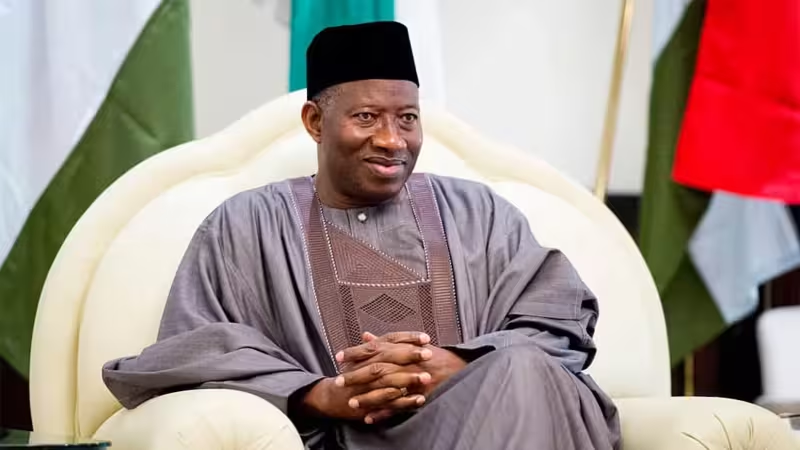
Justice Peter Lifu of the Federal High Court in Abuja on Tuesday dismissed a suit seeking to stop Goodluck Jonathan from contesting the 2027 presidential election.
The suit was filed by Johnmary Jideobi, who had asked the court to stop the Independent National Electoral Commission from accepting, processing or publishing Jonathan’s name as a presidential candidate and to determine whether Jonathan remains eligible under Sections 1,, and 137 of the 1999 Constitution.
Justice Lifu awarded N20 million in costs against Jideobi in favour of Jonathan and ordered N1 million in costs in favour of the Attorney-General of the Federation. The judge said Jideobi lacked the legal right to institute the suit because he had not suffered any loss from Jonathan's perceived intention to vie for the next year's poll.
“I am bound by the above decision of the Court of Appeal and this court, I have no more to add,” Justice Peter Lifu told the courtroom, citing prior rulings that he said had already resolved the issue.
The judge also described the case as an abuse of court process and dismissed a separate motion by Jideobi seeking the judge’s withdrawal from the case. Jideobi had named Jonathan, the Independent National Electoral Commission and the Attorney-General of the Federation as defendants.
The legal fight tested goodluck jonathan 2027 eligibility. Jideobi framed the claim around the argument that Jonathan had taken the presidential oath twice and therefore could not run again. Justice Lifu said a Federal High Court in Yenagoa and the Court of Appeal had already held that Jonathan was eligible.



Jonathan first assumed the presidency in 2010 after the death of Musa Yar'Adua, contested and won the 2011 presidential election, and was defeated by Muhammadu Buhari in 2015. Those milestones were central to the constitutional questions Jideobi asked the court to resolve.
Jonathan has faced repeated calls to return to partisan politics since leaving office. Speaking to youths under the Coalition for Goodluck Jonathan, he acknowledged those calls and stopped short of committing. “Yes, you are asking me to come and contest the next elections,” he told them, adding, “The presidential race is not a computer game, but I’ve heard you, and I’ll consult widely.”
Last week a faction of the Peoples Democratic Party led by Kabiru Tanimu Turaki offered a waiver to Jonathan as the party’s only presidential candidate, a move that fed the legal challenge Jideobi pursued in Abuja.
The court’s dismissal removes the specific legal barrier Jideobi sought to erect. He had asked the judge to bar INEC from processing or publishing any nomination that included Jonathan; the court refused that request and instead penalised Jideobi with substantial costs.
The tension in the case was not only legal but political: repeated public entreaties for Jonathan to return, a factional waiver from within his party, and a private citizen’s attempt to settle the question in court. Justice Lifu treated the suit as both meritless and improperly brought, pointing to earlier judicial decisions that, in his view, settled the matter.
For now, the Federal High Court’s ruling means Jideobi’s attempt to block Jonathan from the 2027 presidential race has failed. The most immediate consequence is that this particular test of eligibility will not prevent Jonathan from pursuing nomination or having his name processed by INEC, unless another legal challenge with standing is filed and succeeds.