




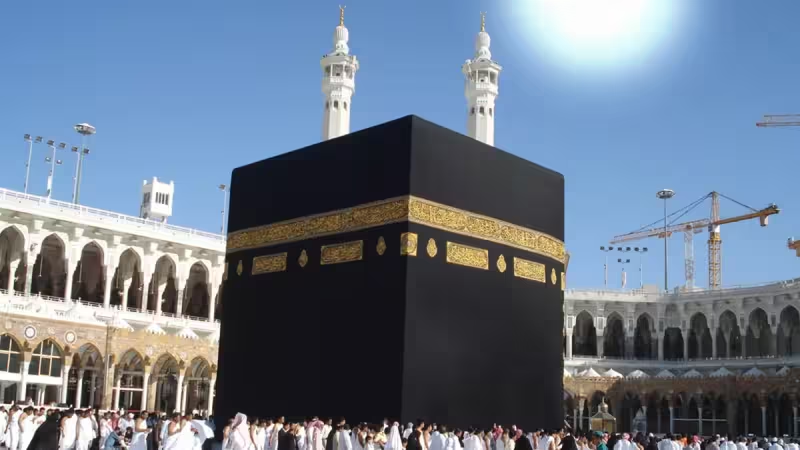
On the Day of Arafah the skies above Mecca witnessed a rare astronomical phenomenon: the sun passed almost directly overhead the Kaaba, producing an almost complete disappearance of shadows around the Grand Mosque at midday.
The moment was described as the first of its kind in roughly 33 years. Astronomers say the effect occurs when the sun reaches its zenith over Mecca's latitude, so that objects at the Grand Mosque cast very short, direct shadows or none at all. The alignment is normally a twice‑yearly event at different times, but experts call its coincidence with the Day of Arafah exceptional because it links to long astronomical cycles.
Numerically, the detail matters: the phenomenon typically happens twice a year, yet the last time the sun and the Kaaba lined up in a way notable enough to be marked on this religious observance was about 33 years ago. At the moment of alignment, the sun’s position provides one of the most precise traditional methods for determining the Qibla without modern equipment, a fact specialists have long used to calculate the direction toward the Kaaba from locations around the world.
The mechanism behind what people saw is straightforward and rooted in latitude geometry: the zenith alignment happens when the sun is precisely at the latitude of Mecca, bringing the sun nearly overhead at the Grand Mosque. Shadows shrink to the shortest possible lengths at local noon, turning minarets and columns into brief spikes rather than long slanted forms. That optical effect is what allowed observers to mark the alignment so clearly on this Day of Arafah.

Context sharpens the rarity. While the sun’s alignment with the Kaaba is not itself unheard of — occurring twice yearly under ordinary solar motion — the concurrence with a particular calendar day used by millions for pilgrimage rites is unusual. Long astronomical cycles shift the calendar relationship between solar position and fixed religious dates, so that rare overlaps reappear only after decades.
The practical value of the phenomenon is tangible. For generations, scholars and navigators have relied on the zenith alignment as a field method to set a direct bearing toward the Kaaba. In places where compasses or modern instruments are unavailable, the moment when shadows concentrate directly beneath objects gives a rapid, highly accurate reference for the Qibla that needs no electronics.
There is a built‑in tension between the method’s precision and its infrequency. It is one of the most accurate traditional techniques for finding the Qibla, yet its usefulness on any given day is limited because the precise solar alignment happens only at specific times, usually twice a year but rarely on the same religious observance. That mismatch — high precision against a low probability of useful coincidence — is the reason the event is noteworthy rather than routine.
For observers in Mecca the effect is immediate and visible; for people elsewhere it carries different meaning. Specialists use the timing to compute exact bearings to the Kaaba across countries, but most worshippers encounter its importance symbolically when the horizon at the Grand Mosque seems briefly to lose its shadows and the usual geometry of light around the Kaaba simplifies into a single, vertical rule.
The single question left sharpest by the alignment is straightforward: after a convergence that has not been seen in about 33 years, when will the next such coincidence fall on the Day of Arafah? The answer lies in celestial cycles, not calendars, and the timing of that next overlap will determine whether this moment is a rare, once‑in‑a‑generation curiosity or the start of a pattern of more frequent calendrical encounters.