




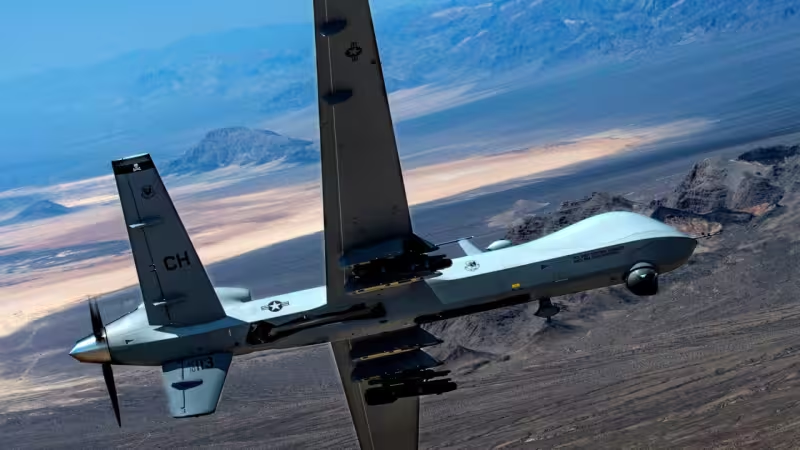
The U.S. Air Force finalized requirements in May 2026 for a next-generation successor to the General Atomics Mq-9 Reaper that prioritizes attritable design, lower cost, mass production and open-architecture flexibility.
Tim Hawkins, a U.S. military spokesman, framed the move against a backdrop of combat operations, saying, "US forces conducted self-defense strikes in southern Iran today to protect our troops from threats posed by Iranian forces," and later adding that "US Central Command continues to defend our forces while using restraint during the ongoing ceasefire," as regional tensions mounted.
The change is stark in scale: combat losses in Iran operations reduced the active Reaper fleet to 135 aircraft after 54 confirmed Reaper losses in 2025, and replacement costs for lost airframes exceeded $1.6 billion. The baseline Reaper cost was roughly $34 million per aircraft in 2024 dollars, excluding sensors, and Air Force planners say lowering that price to between $8 million and $15 million would allow procurement of two to four times more airframes within current budgets.
That arithmetic — buy many cheaper airframes instead of a smaller number of expensive, highly survivable ones — is the operative logic behind the new requirements. The MQ-9 Reaper entered service in the mid-2000s and has been a centerpiece of U.S. air dominance in limited conflicts ever since, prized for long loiter and multi-mission payloads: 27-hour endurance, a 240-knot cruise speed and a 3,850-pound payload capacity.



The successor program explicitly accepts trade-offs. The new platform is intended to allow controlled loss rates rather than maximize survivability through advanced sensors and defensive systems, and planners acknowledge reductions in endurance and lower-altitude capability as part of the cost equation. Requirements also insist the drone support electronic warfare jamming, reconnaissance and strike operations — a recognition that contested airspace will remain central to mission sets.
Those contested skies are precisely what sharpened the policy pivot. On Tuesday Iran's Revolutionary Guards said they shot down an MQ-9 Reaper drone after identifying a hostile aircraft in Iran's airspace in the Gulf region, and they said they fired at an F-35 fighter and an RQ4 intelligence collection drone. Iran's Foreign Ministry accused the United States on Tuesday of breaching a ceasefire agreement in Hormozgan within the previous 48 hours, and the Guards said they had fired at U.S. aircraft they said were attempting to enter Iranian airspace.
Here is the tension that will define the program: planners want drones cheap enough that loss is acceptable, yet operations in places such as the Gulf and Hormozgan demand platforms that can survive electronic attack, surface-to-air threats and hostile rules of engagement. The Air Force is betting that mass, flexibility and open architectures — systems that can be produced quickly and reconfigured with new sensors and jamming suites — will blunt those risks more effectively than hanging the mission on a smaller number of expensive, hard-to-replace aircraft.
What the Air Force has done is explicit: it has redefined what a combat unmanned aircraft should be. The service is moving away from a model built around high-dollar individual survivability and toward one that treats losses as a controllable cost of operations, buying numbers, modularity and rapid fielding instead. That shift will change how the United States projects air power in contested regions and how commanders on the ground reconcile force protection with the need to maintain persistent surveillance and strike options.