





Taipei said a chinese aircraft carrier liaoning sailed through the Taiwan Strait and was closely monitored. (confirmed)
Taipei Monitoring the Transit
Taipei reported the carrier transit during a Friday briefing and said naval and air units tracked the vessel’s movement while local authorities kept an operational watch. (confirmed) The statement placed the transit at the centre of the day’s security reporting by Taipei and underlined the island’s routine of active monitoring when large People’s Liberation Army assets operate nearby.
China Ministry of National Defense
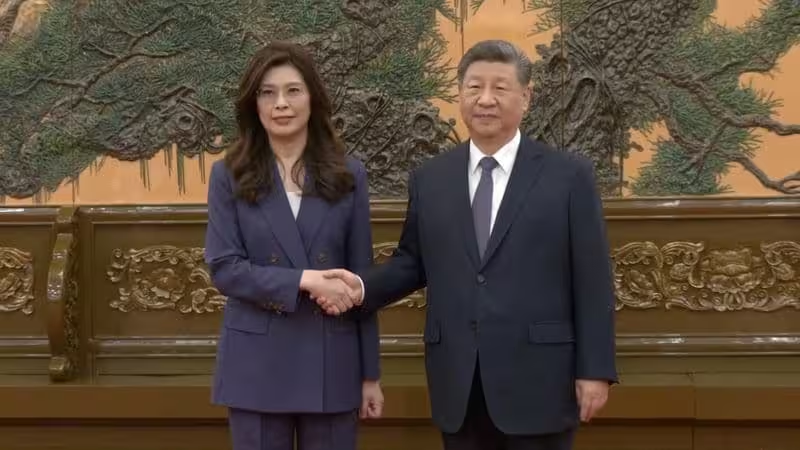
Zhang Xiaogang, spokesperson for China’s Ministry of National Defense, addressed the same Friday briefing and framed Beijing’s position. Zhang said ""Taiwan independence" is the root cause of tension" and described PLA drills and training around Taiwan Island as "“completely legitimate, reasonable, and entirely justified”" (claimed by Zhang Xiaogang). Zhang also said "the Democratic Progressive Party authorities were distorting and hyping PLA actions, peddling war anxiety, and intimidating people on the island" and called U.S. assertions about Chinese military pressure "a complete distortion of the facts and harbours malicious intentions." (claimed by Zhang Xiaogang)
U.S. Congress Members Visit Taiwan
Zhang Xiaogang said several U.S. Congress members visited Taiwan and that those visits included urging local authorities to fast-track a "special defense budget." (claimed by Zhang Xiaogang) Zhang added that Taiwan leader Lai Ching-te "expressed gratitude and advocated military cooperation with the United States," and Zhang condemned that stance by saying "There is no such thing as a “defense budget” for Taiwan." (claimed by Zhang Xiaogang)
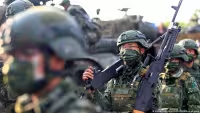
Support for Beijing’s framing appears alongside other recent Chinese activity: China has stepped up military activity around Taiwan and has held several rounds of war games, most recently live-fire drills in late December. (confirmed) That sequence — drills in late December followed by a carrier transit reported on a Friday briefing — is the timeline Taipei and Beijing both used to justify their competing narratives.
The friction in this episode is clear in competing actions and words. Taipei’s monitoring of the Liaoning transit signals operational attention on movement through the Taiwan Strait, while Zhang Xiaogang’s remarks cast Taipei’s reporting and U.S. contacts as provocations that Taipei’s authorities and visiting U.S. lawmakers are promoting. (disputed)
Lai Ching-te remains the named political figure whose public expressions of gratitude toward U.S. visitors and calls for deeper cooperation make him the focal point of Beijing’s criticisms; his position also shapes how Taipei frames responses to future transits. (confirmed)
For residents and officials on Taiwan, the immediate change is procedural: Taipei’s security services continue active tracking of PLA movements and will brief the public or adjust watch levels as required. For policymakers, the urgent open question is whether Taipei’s monitoring and public reporting of transits will alter the pace of U.S.–Taiwan security contacts that Zhang Xiaogang criticised. (open question)