





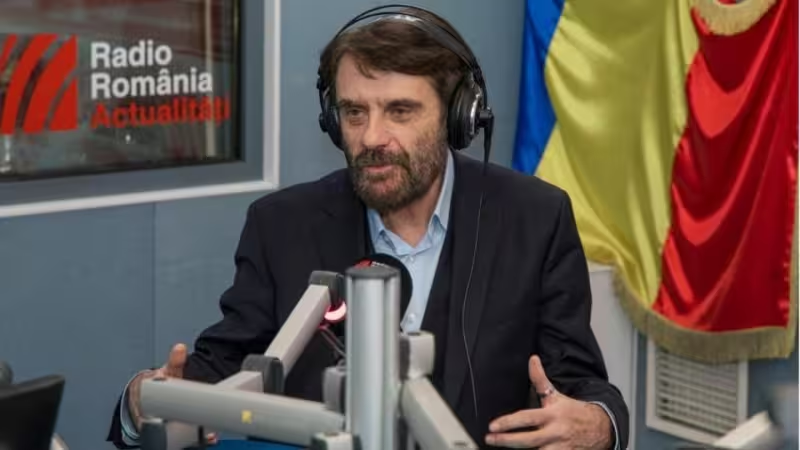
Radio Chișinău has reached 15 years of uninterrupted broadcasting and, on 28 May 2026, Societatea Română de Radiodifuziune issued a formal statement defending the station’s legitimacy — a communiqué echoed by Robert C. Schwartz, who described the outlet as a necessary source of correct, balanced and relevant information, cultural and educational programming and entertainment. The station was launched on 1 December 2011 and SRR marked 2026 as its fifteenth consecutive year on the air.
That anniversary and the SRR defence explain why searches for moldova country are returning the station’s name now: Radio Chișinău is an explicitly Romanian‑language presence aimed at listeners in the Republic of Moldova and at interests in Romania, operating in a media environment where many outlets broadcast in Russian or in both Russian and Romanian. SRR says the project was created to provide an alternative voice in that landscape, and the timing of the message — tied to the 15‑year milestone — has focused attention on who controls and hears Romanian‑language media across the border.
SRR’s statement underlined the broadcaster’s purpose in concrete terms: it said Radio Chișinău serves the Romanian community in the Republic of Moldova and Romania’s national interest, contributes to promoting Romanian cultural, linguistic and spiritual values, and represents a genuine bridge between Romania and the Republic of Moldova. The public broadcaster framed the 2011 launch as the relaunch of Radio România’s presence in Chișinău after a 72‑year interruption that began following the inauguration of Radio Basarabia in 1939, describing Radio Basarabia as the first regional studio of the Romanian Radio Broadcasting Society and the second after Radio București.
Those institutional claims sit against a more complicated reality. The station broadcasts exclusively in Romanian, which is precisely why its use of spectrum in the Republic of Moldova has become a subject of recent public debate — a dispute framed in some coverage as a controversy over the preluarea frecvenței pe care emite Radio Chișinău. The debate intensified after a recording published in November 2025 revealed vulgar language by Demeter András István, who had been the president‑director general at the time of Radio Chișinău’s 2011 launch; Demeter announced his resignation from the Ministry of Culture on Monday evening and issued apologies for creating division, saying he does not cling to office and steps down when he believes it is right. Those developments have given critics material to question whether the station’s uninterrupted run and public‑service mantle are free of political and managerial strain.
SRR and Robert C. Schwartz offered a direct counterweight to those doubts. SRR insisted it is important to reaffirm that Radio Chișinău is a legitimate and necessary project in the service of listeners in the Republic of Moldova and of Romania’s national interest, and SRR stressed the station’s role in promoting cultural and linguistic ties. Schwartz’s communiqué reiterated that the station provides access to correct, balanced and relevant information alongside cultural, educational and entertainment content. Yet neither the anniversary statement nor Schwartz’s defence addressed the mechanics of the frequency dispute or mapped a resolution process for the technical and legal questions now in play.
The most consequential unanswered question after this anniversary is straightforward and immediate: will the dispute over the frequency used by Radio Chișinău be settled in a way that preserves the station’s uninterrupted Romanian‑language service, or will regulatory or political pressures force changes that could interrupt it? SRR’s reaffirmation and Schwartz’s defence secure a narrative of public service; what remains to be seen is whether that narrative will be matched by a durable settlement of the frequency issue and clear safeguards for the station’s editorial and operational continuity going forward.