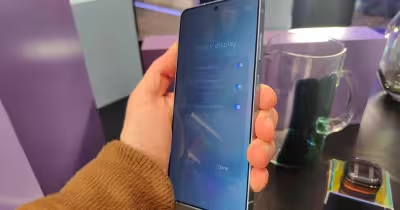




Google is expected to release the stable version of Android 17 in June 2026, and Samsung will follow by delivering the update as One UI 9 to eligible Galaxy devices, with the first One UI 9 beta already announced in mid-May.
Samsung’s newest flagships — the Galaxy S26 series, released in late February 2026 — are likely to be first in line for Android 17 as One UI 9; Samsung has promised seven years of updates for those phones, a level of promised support that puts them at the front of the rollout.
The scope of the upgrade is broad but selective: devices released in 2023, including the Galaxy S23 series, will also be upgraded to Android 17 at some point, and Samsung says owners of Galaxy A, Galaxy M, Galaxy F and Galaxy XCover handsets bought in the past three years will get Android 17 as well.
Samsung will update several tablets to Android 17 too, covering Galaxy Tab S flagships and more affordable Galaxy Tab A models that are eligible and were launched in 2023 or later.
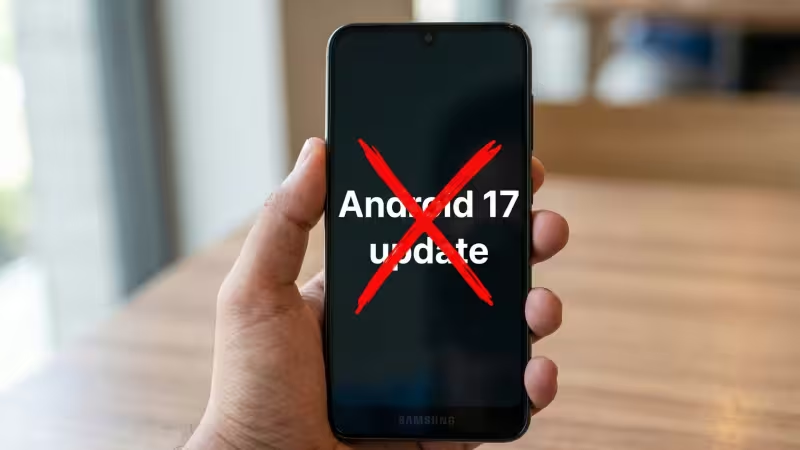
At the same time, a clear cutoff is visible: phones launched in 2022 or earlier have a strong chance of not getting Android 17. The Galaxy S22 series, which launched in February 2022 on Android 12 and has already received Android 13, Android 14 and Android 15 as One UI 7, and Android 16 as One UI 8, will not receive Android 17.
Samsung is already rolling One UI 8.5 to the Galaxy S22 starting around May 26, 2026, after which the S22 family will move to quarterly security patches until approximately February 2027. The S22 therefore reaches the end of its major-OS upgrades with Android 16.
The pattern repeats across other 2022-era devices. The Galaxy S21 series — launched in January 2022 on Android 12 — will also stop at Android 16 and will not receive Android 17, though it is eligible for One UI 8.5 and will shift to quarterly security patches afterward.


Samsung’s 2022 foldables followed the same timeline: launched in August 2022 on Android 12, they received One UI 8 as Android 16 in October 2025 and are now in testing for One UI 8.5 on the Galaxy Z Fold 4 and Galaxy Z Flip 4; after 8.5 lands, those models will move to quarterly security patches with support expected through roughly 2027.
The Galaxy S20 series is already retired: its final OS was Android 14 as One UI 6.1, and reports in February 2026 said the S20 line was dropped entirely from Samsung’s update roster. Software support for the Galaxy S10 and Note 10 series ended with the August 2025 security patch, with Android 13 as the final OS.
Not every eligible phone will get every Android 17 feature. Samsung launches Android updates under the One UI label — Android 17 will be called One UI 9 — and while the company will push the version to many models, high-end features introduced in Android 17 may not reach lower-spec hardware on some eligible devices.
New Samsung phones that ship after Google’s Android 17 rollout will probably run Android 17 out of the box; that includes models such as the Galaxy Z Fold 8 and Galaxy Z Flip 8, which are expected to arrive already on One UI 9.
For owners, the picture is straightforward but consequential: if you bought a Galaxy S26 or a 2023 model, Android 17 as One UI 9 is coming; if you own a 2022 or older phone, the odds are that Android 17 — and the new major features it brings — will not reach your device.
The immediate questions for users are timing and feature parity. Samsung will stagger the rollout, with the Galaxy S26 first and older eligible phones following later, while some 2022-era devices move off major-OS upgrades and onto limited quarterly security support.
If you are weighing an upgrade for future features or long-term OS coverage, the safest bet is to choose devices launched after Google’s June 2026 stable release — those phones are the ones most likely to arrive on Android 17 and to receive the longest span of updates under Samsung’s current policy.