




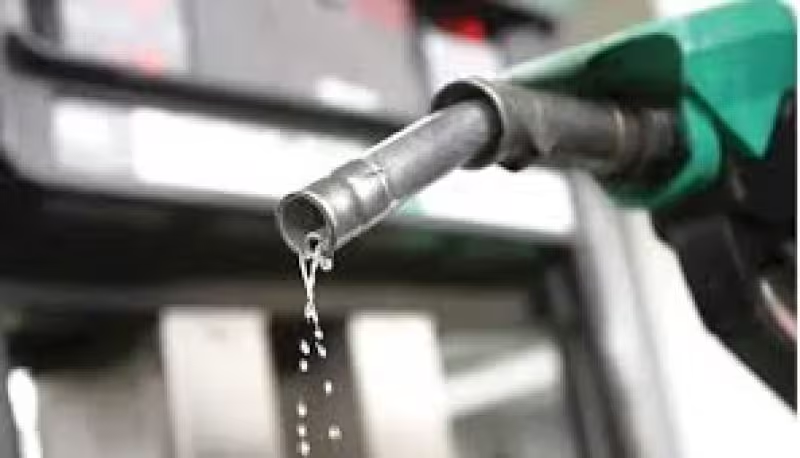
A senior management official of the Dangote Group said on Monday that the Dangote Petroleum Refinery has been subsidising the petrol and diesel it sells to the Nigerian market, a disclosure that landed as airlines warned they might shut down after jet fuel prices exploded.
The official told reporters the refinery’s ex‑depot petrol price of N1,200 per litre is below a competitive market level and that the company had moved its gantry price from N774 to N1,200 by the time of the report. The rise followed a global crude spike — Brent rose from $66 per barrel on February 28 to above $100 a barrel — after fighting between the United States and Iran and disruptions in the Strait of Hormuz.
That surge, Dangote officials said, touched diesel and aviation fuel as well. “With the crude price moving up steeply, we try to optimise the price of PMS (petrol) as much as possible to help the public. To some extent, we try to optimise the price of AGO (diesel) too. We can’t be subsidising everything, and so, we sell the jet fuel at the market price,” a Dangote refinery official said.
The same official added exact figures on jet fuel supply: "I can confirm to you that our jet fuel price as of this (Monday) morning is N1,799. It was even lower before this time. That’s how much we sell to the marketers who later sell to the airlines. We are selling at less than N2,000 a litre," the official said.
Those numbers sit uneasily beside what airlines and some marketers are charging. Allen Onyema, who represents carriers, said prices had jumped far higher: "the price of Jet A1 as sold by marketers has risen significantly from the initial N900/litre as at February 28, 2026, to N3,300/litre as of today." A letter dated April 14, 2026, from Abdulmunaf Sarina, President of the Airline Operators of Nigeria, warned that the spike in Jet A1 had become "unbearable" and that operators were planning to shut down after increases of over 350 per cent in Jet A‑1 prices.



Industry reports show a split between locally supplied gantry prices and the rates airlines are reporting. A Major Energies Marketers Association of Nigeria report last week put Dangote’s jet fuel gantry price at N1,732 per litre while the same report put imported aviation fuel at N1,835 per litre. Another Dangote Group official told reporters the company’s aviation fuel was being sold to marketers below N2,000 per litre and that on Monday morning the price to marketers was N1,799 per litre.
The difference is consequential. Dangote supplies over 90 per cent of Nigeria’s aviation fuel needs, and airlines say marketers have remained largely silent about how they set prices once the fuel leaves Dangote’s gantries. One industry report said Dangote had optimised petrol and diesel prices to blunt the shock of crude, while acknowledging that jet fuel could not be subsidised in the same way.
The tension is straightforward and sharp: Dangote says it is selling jet fuel at roughly N1,700–N1,800 per litre, but airlines and some marketers are reporting retail jet fuel prices as high as N3,300 per litre — a gap that has pushed carriers toward grounding. The company’s stated move to keep petrol at N1,200 per litre — up from N774 earlier in the crisis — is presented by the refinery as an active subsidy to protect road transport users even as global crude climbs.
That friction raises two urgent questions. First, why are marketers charging airlines many times the refinery's gantry price, and second, how long can carriers absorb those margins before cutting routes or closing operations? The PUNCH reported attempts to get fuel marketers to disclose their selling prices to airlines met with silence, leaving a gap between the Dangote numbers and the rates passengers are being asked to pay through cancelled flights and higher fares.
For now, the immediate reality is written in prices and warnings. The dangote refinery’s intervention lowered the cost of petrol and diesel at a moment of global oil shock. But because the refinery says it cannot subsidise jet fuel, and because marketers appear to be selling Jet A1 at far higher levels than the refinery’s gantry, airlines remain at risk of collapse if the spread between supply price and what they are forced to pay is not closed.