




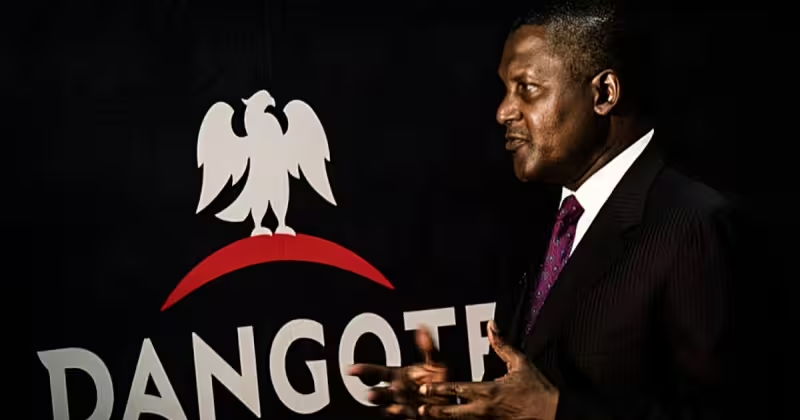
Aliko Dangote announced in Lagos during his induction as an Honorary Fellow of the Nigerian Academy of Engineering that he will expand the Dangote Refinery to a production capacity of 1.4 million barrels per day and said the project could employ about 95,000 skilled workers on site at its peak.
Dangote said the upgraded facility would surpass India’s Jamnagar Refinery to become the world’s largest refinery by capacity and that the development would strengthen Nigeria’s domestic refining capability, reduce reliance on imported fuel and ease pressure on foreign exchange reserves.
At the ceremony he accepted the honour by telling the academy: "This award is particularly meaningful because it recognises what we are doing in the industry," and later framed the expansion as a vote of confidence in local talent. "The scale of this expansion reflects our confidence in Nigerian capacity and our belief that Africa can build world-class infrastructure," he said.
The numbers Dangote is offering are stark: 1.4 million barrels per day and roughly 95,000 skilled jobs during peak construction. The project is pitched not only as a capacity play but as an industrial pivot—Dangote said the expansion would rely heavily on local expertise and would create opportunities for engineers, technicians, and artisans while driving technology transfer that will support the broader oil and gas value chain.
Prof. Rahamon Bello, president of the Nigerian Academy of Engineering, explained why the induction mattered. "It is a Think-tank founded in 1997, comprising eminent Nigerian and foreign engineering professionals who provide leadership on national engineering and technological matters," he said, noting that in the academy’s 29-year history only five Honorary Fellows had been inducted and that the event produced the sixth.



The announcement builds on a refinery that is already described in reporting as Africa’s largest and on a Dangote Group that, Dangote said, has built a refinery with a capacity of "more than 50 per cent of any that has been built in the world." He added that the group is Nigeria’s largest employer of engineering and technology graduates and that engineers make up "over 15 per cent of the workforce across Dangote Petroleum Refinery and Petrochemicals, Dangote Fertiliser, and other Dangote businesses." Round Time News has previously covered earlier milestones in the group’s oil push, including initial crude production reports and other project proposals.
The plan is pitched as a direct answer to two policy problems: a chronic dependence on imported refined fuel and the strain that imports place on foreign exchange reserves. Dangote’s pitch is that lifting refining capacity at home will reduce those pressures and anchor broader industrialisation.
There is an immediate tension inside the announcement. Dangote promised tens of thousands of skilled construction roles and said the project would depend on local engineers and artisans — yet he also flagged a disruptive new variable. "Today, we are witnessing the impact of artificial intelligence in virtually all spheres of life," he said. "It is possible that AI will soon phase out engineering designs usually undertaken by human engineers. I call on engineers to step in and lend their voice on the ramifications of AI to their profession on how it is being taught and practised." The contradiction is clear: a project that hinges on large-scale local manpower is being planned at the same time its primary field faces potential automation.
That tension sharpens two practical questions for what comes next: can Nigeria supply and train the tens of thousands of skilled workers Dangote says the build will need, and how will the industry manage the infusion of AI-driven design tools he says are imminent? Dangote framed engineering as central to industrial progress — "Engineering is more than a profession. It is a language of progress," and "No nation can industrialise without the ingenuity of engineers." His induction into the academy makes that argument personal: the man promising the expansion is now recognised by the country’s leading engineering think-tank.
If the expansion proceeds as Dangote described, it would reshape the scale of refining capacity on the continent and alter Nigeria’s trade and industrial footprint. For now, dangote’s pledge links grand capacity targets with promises of jobs and technology transfer, even as he warns the very nature of engineering work may be changing. The most consequential test ahead is whether those local skills can be mobilised and adapted fast enough to match both the sheer scale of the build and the disruptive forces he himself flagged.