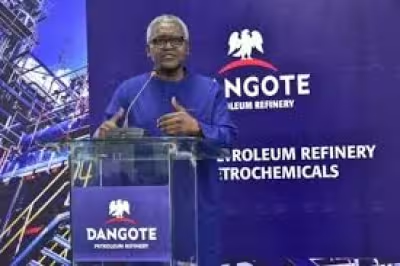





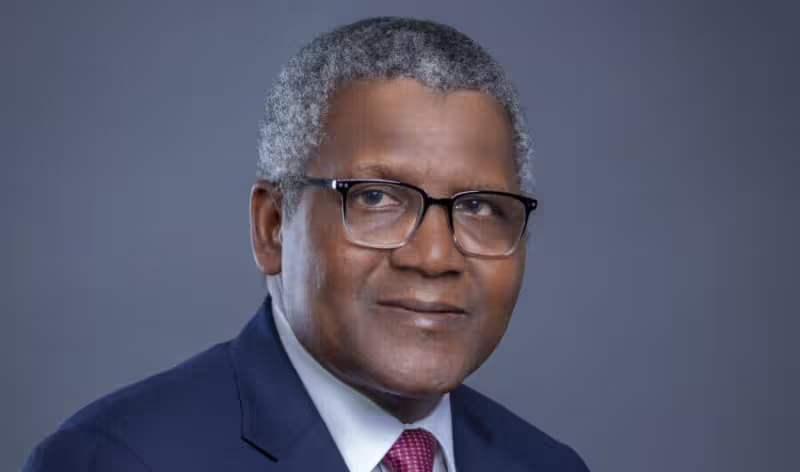
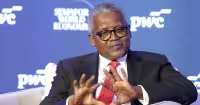
Aliko Dangote told the Africa We Build Summit 2026 in Nairobi on Thursday that he would build an identical 650,000 barrels-per-day refinery in East Africa if Kenya's President William Ruto and Uganda's President Yoweri Museveni backed the project.
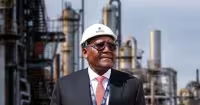
"I can give commitment to the two presidents that were here; if they will support the refinery, we’ll build the identical one that we have in Nigeria – 650,000 barrels per day," Dangote said, and he added the proposed plant would be sited in Tanga, Tanzania, with a pipeline linked to Mombasa port to serve Kenya, Uganda and neighbouring eastern African countries.
Dangote said piling had already started on the venture he described as under way and argued the work would ultimately be scaled far beyond the 650,000 figure. "There is nothing that can stop it. We have done the one in Nigeria and that’s why we are taking the bold move which was started already. Piling has started, while building to a scale – 1.4 million barrels per day will give us the largest refinery – world number two," he said.
He framed the 1.4 million barrels-per-day ambition in stark global terms. "It is 10% of entire United States of America’s refining capacity," Dangote said, and he said the project would include petrochemicals that the region now imports.
Dangote linked the refinery plan directly to downstream industrial needs. He noted polypropylene — used in cement, flour, rice and grains — as a key product the plant would supply and warned of sharp price volatility, saying the cost of polypropylene rose from $900 to $3,000 in 45 days.
Those arguments, and the promise of local petrochemical production, underpin the case he made for regional self-reliance. "And this is coming with lot of, you know, petrochemicals," Dangote said. "So, that is why we must learn how to build self-sufficiency." He also praised Uganda's president for a recent decision to stop exports, saying it was a step toward protecting local supply.
The plan Dangote laid out carries an immediate tension: he offered to "build the identical one that we have in Nigeria – 650,000 barrels per day" if Presidents Ruto and Museveni support the project, while at the same time describing piling as under way on a venture he expects to expand to 1.4 million barrels per day. That gap — between an "identical" replication and a leap to the world's second-largest refinery — raises questions about the project's design, financing and regional approvals.
Dangote sought to blunt doubts about financing, saying big banks are eager for large projects. He told the summit that major financial institutions were "hungry for big ticket items," and urged a can-do approach: "Africans can do it. Let us not be scared."
The immediate test, by Dangote's own terms, is political: his pledge requires explicit support from the two presidents he singled out. If Ruto and Museveni formally back the plan and the governments of Kenya, Uganda and Tanzania agree to host, route and permit a Mombasa-linked pipeline and a Tanga refinery, the project could proceed; without that backing, the proposal will remain an outline announced on a summit stage.
The article says comments expressed in the story do not reflect the opinions of Vanguard newspapers or any employee thereof.