




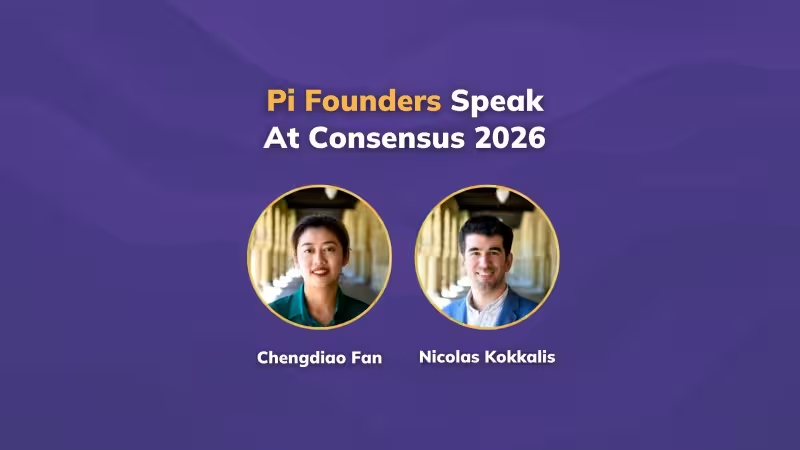
Chengdiao Fan, one of Pi Network’s founders, will step onto the Convergence Stage in Miami on May 6 to set out the project’s pitch for tying blockchain, verified identity and AI-driven products to real-world utility.
Fan’s talk — scheduled for May 6, 11:15–11:35 AM EDT and billed as “Aligning Web3, AI, and Blockchain for Utility” — is the first of two sessions at Consensus 2026 that put Pi’s approach to authenticity and identity at center stage. On May 7, 10:15–10:45 AM EDT, Nicolas Kokkalis, another of Pi’s founders, will join a Convergence Stage panel titled “How to Prove You’re Human in an AI World (Without Doxing Yourself).” Together the appearances formalize Pi Network’s role in the public debate at pi network consensus 2026 in Miami on May 6 and 7.
The scheduling is precise: Fan has a 20-minute slot on Wednesday morning, and Kokkalis appears in a 30-minute panel on Thursday. Those session titles map directly to the problem Pi says it is tackling — proving real human identity online as generative AI lowers the cost of building convincing bots and fake profiles. The packed program puts the company’s native KYC solution and its claims about blockchain-enabled authenticity on full display to developers, investors and privacy-focused technologists attending Consensus 2026.
Pi says its blockchain infrastructure, verified identity, globally engaged network and native KYC solution support utility-driven products and authenticity solutions. In advance materials, the project frames those tools as the backbone for sustainable business models built around trusted human participation rather than inflated engagement numbers or synthetic accounts. Fan’s advertised talk promises to connect the dots between Web3 protocols, AI-era product design and the kinds of utility that, Pi argues, will reward networks that can guarantee authentic human actors.


Context matters: Pi’s sessions land amid a broader industry reckoning over identity and trust online. Pi says AI is lowering barriers to building products and increasing competition around authentic data, user acquisition and trusted human participation, and that the internet’s trust model is breaking as AI systems can create profiles and interact like real users. The two founder-led sessions at Consensus 2026 will be watched for concrete examples of how Pi’s systems — from on-chain mechanics to its KYC layer — might be composed into commercially viable services that still respect user privacy.
There is an unavoidable tension at the heart of the presentations. Pi says it provides authenticity solutions through its native KYC solution, but Kokkalis’s panel title — stressing ways to prove you are human without doxing yourself — highlights the privacy trade-offs most digital identity projects face. Proving humanness typically requires attestation; attestation can require personal data. The flip side is the industry’s need for reliable signals of real users so that AI-era products can buy, sell or reward human attention without being gamed by synthetic actors.
The question that will hang over both sessions is concrete: can Pi’s combination of blockchain infrastructure, verified identity and a globally engaged network authenticate humans at scale without forcing users to expose sensitive personal data? If Fan and Kokkalis provide technical detail and user-facing examples, they will transform marketing language into testable claims. If they stick to high-level visions, observers will walk away with the same uncertainty that surrounds most identity efforts — promising frameworks, few standards and hard choices about privacy versus provenance.
For attendees on May 6 and 7, the conversations on the Convergence Stage will be an early measure of whether Pi’s pitch can move beyond concept and into products that change how online communities, marketplaces and AI systems verify participation. For everyone else watching from afar, the most consequential unanswered question is whether Pi’s model can deliver both the authenticity the AI era demands and the privacy users expect.