




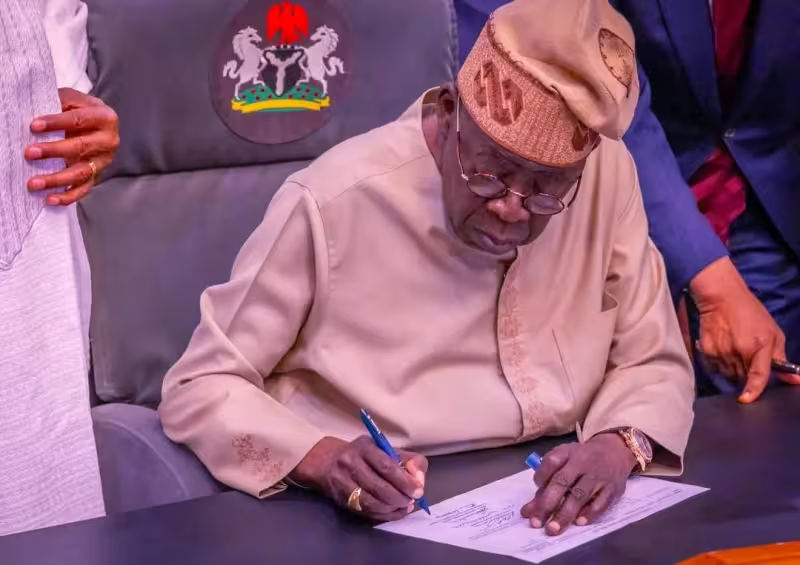
President Bola Tinubu on Thursday asked the Senate to approve a $516.3 million foreign syndicated loan to help finance construction of the Sokoto-Badagry highway, a 1,000-kilometre road that would cut across seven states from Illela to Badagry.
Senate President Godswill Akpabio read the request at plenary and sent it to the Senate Committee on Local and Foreign Debts, directing the panel to report back within one week. The loan facility is to be arranged through Deutsche Bank AG and backed by a partial risk guarantee from the Islamic Corporation for the Insurance of Investment and Export Credit, while the Federal Government will provide more than 265 billion naira in counterpart funding for land acquisition, compensation and related infrastructure.
The financing plan is structured over nine years with a three-year grace period, and interest is pegged at the Chicago Mercantile Exchange SOFR plus 5.3 per cent a year. The Federal Executive Council had already approved the plan before it reached the upper chamber, placing the Senate at the next checkpoint for one of the administration’s biggest road proposals.


The request matters now because it comes as the government pushes the Sokoto-Badagry superhighway as a flagship infrastructure project and a link between the North-West and the South-West. The road is meant to connect Sokoto, Kebbi, Niger, Kwara, Oyo, Ogun and Lagos states, turning a long-discussed corridor into a formal financing test.
But the loan also landed in the middle of a fresh political fight over Nigeria’s borrowing. Former Vice President Atiku Abubakar objected on Thursday, saying the country is already “groaning under the weight of unsustainable debt” and warning that the request raises questions about prudence and accountability because transparent terms, a clear cost-benefit analysis and a credible repayment framework were missing.
Atiku urged lawmakers to subject the proposal to rigorous scrutiny and tied his criticism to the Lagos-Calabar Coastal Highway, saying Nigerians have not forgotten questions over its opaque award process. “Public infrastructure cannot become a private bazaar for cronies and connected interests,” he said, adding that every kobo borrowed in the name of Nigerians must be matched with transparency, accountability and strict adherence to procurement laws. “Nigeria must build, but Nigeria must not borrow blindly,” he said. “Progress anchored on opacity and debt accumulation is neither progress nor leadership—it is postponement of crisis.”
The Senate committee now has one week to examine the request, and that review will determine whether the financing moves forward or becomes the latest test of how far the legislature is willing to go in signing off on the administration’s borrowing drive.