




Honor launched its new N series in Europe today, unveiling the Honor 600 as the lower-cost member of the family alongside a pricier Honor 600 Pro.
The headline is how close the two phones look on paper: the standard Honor 600 shares a 6.57-inch 120Hz AMOLED display and the same 200-megapixel main camera and 12MP ultrawide camera as the Pro, and both handsets carry IP69K water resistance and 80W wired charging. Yet the 600 is built to be the entry-level model — it drops the Pro’s third rear lens used for zoom and uses a Snapdragon 7 Gen 4 chipset instead of the Pro’s Snapdragon 8 Elite.
Those numbers are concrete. The Honor 600 packs 12GB of RAM, a claimed peak HDR brightness of 8,000 nits on its display, and in some markets a 7,000mAh battery; buyers in Europe will get a 6,400mAh cell. Charging runs to 80W wired and the phone supports 27W wireless reverse charging; full wireless charging is reserved for the Pro. Honor priced the 600 at €649.90 in Europe today; the Pro appears at €999.90.
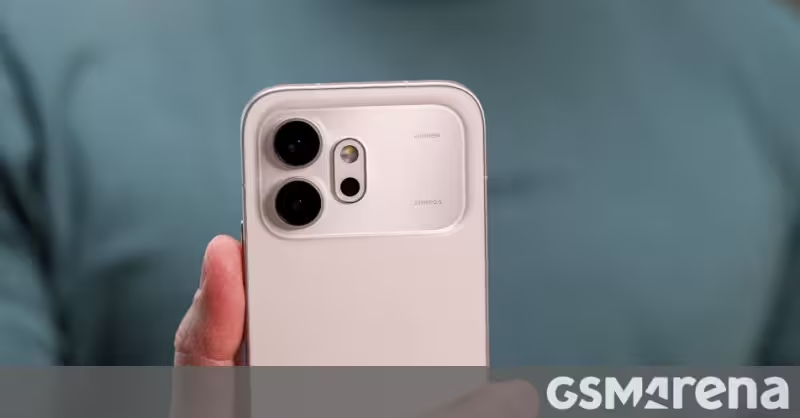
Design makes the split obvious: the Honor 600 shows two prominent rear camera lens rings set in a wide rectangular frame, while the Pro keeps a triple-camera layout to accommodate its telephoto hardware. Honor introduced the pair as the 600 and 600 Pro and, in marketing language provided with the launch, positioned them as more affordable ways into the flagship experience.


Context matters here. Honor has been moving quickly since last year’s Honor 500, and company messaging around these phones frames them as 'accessible flagships' — devices that borrow headline specs from high-end models while trimming some features to hit lower price points. That approach explains why the 600 keeps the very large 200-megapixel sensor and high-refresh OLED, yet sheds the Pro’s dedicated 3.5x telephoto module and the convenience of built-in wireless charging.
The tension in that strategy is immediate and practical. On paper the Honor 600 looks like a generous value: a 200MP main camera, wide OLED with extreme claimed brightness, huge battery for non-European buyers, and modern charging speeds. But the phone’s photographic toolkit is incomplete compared with the Pro. Removing the telephoto lens curtails optical zoom capabilities, and leaving wireless charging to the pricier model creates a clear functional gulf despite the similar displays and sensors.
Another wrinkle: Honor lists two different battery sizes depending on market — 7,000mAh in some regions and 6,400mAh in Europe — which means the experience could vary dramatically by buyer location even inside the same model name. The Snapdragon 7 Gen 4 chip will likely deliver strong mid- to upper-range performance, but it is a step down from the Snapdragon 8 Elite that powers the Pro, and that difference is a key part of the €350 price gap between the phones in Europe.
If you came here looking for an honor 600 pro review that helps decide which phone to buy, the decision will revolve around three trade-offs: whether you need optical zoom, whether you want native wireless charging, and how much you value the faster chip in day-to-day use. The 600 punts on a couple of flagship conveniences while keeping headline specs that make for big marketing numbers; the Pro keeps those conveniences and the higher-end silicon for a substantially higher price.
The single most consequential question now is whether the Honor 600’s pared-back hardware and lower price will be enough to convince buyers to choose it over the Pro — or if the lack of a telephoto lens, no built-in wireless charging, and a less powerful chipset will push upgrade-minded customers straight to the €999.90 model.