





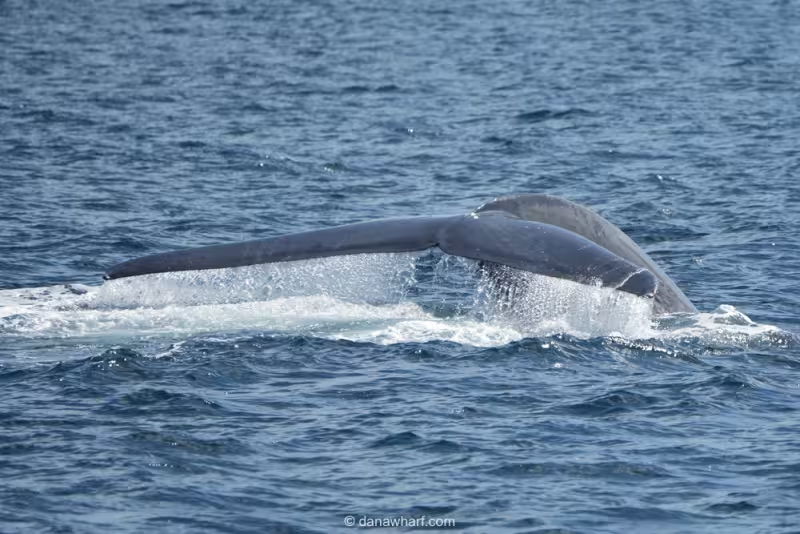
The first blue whale of the season was spotted Tuesday about 3 miles off the Dana Point Headlands, and a blue video taken by a nearby charter boat showed the whale blowing water a few times before descending, Dana Wharf Whale Watching Captain Branden Erdo reported during an excursion.
Erdo said the animal was immediately identifiable. "Once the tail fluke came out, we realized right away it was a blue whale," he said after the sighting, which witnesses estimated at about 80 feet long and believed to be the whale nicknamed Bubbles.
Guests aboard Capt. Dave’s Dolphin & Whale Watching Safari also saw the animal feeding, operators said, a rare early glimpse of behavior that usually becomes common later in the season. The whale’s long, gray-blue body and repeated blows were caught on video that the charter operators played for passengers back on shore.
For the people who make a living showing visitors the ocean, the numbers matter: blue whales typically arrive in May, peak in July and August, and begin to taper off by early fall. That calendar is why this sighting — a day before Earth Day, as local guide Nona Reimer noted — landed as news. "We like to think of them as our summer whale," Reimer said, "but here it is a day before Earth Day."
Reimer put the encounter in larger perspective with a handful of blunt facts visitors rarely carry home with them. "It’s the longest, the loudest, the largest animal that has ever lived on this planet," she said, and she reminded audiences that only a tiny fraction of humanity ever sees one. "When I think about the fact that there’s over 8 billion people on the planet, how many are privileged enough to get on a boat on the water? And then how many get to go whale watching? That’s even fewer," Reimer said. "And how many get to see the largest, longest mammal to ever live? Less than 1% ever have that privilege."
Blue whale sightings off Southern California can still surprise. About 50 years ago there were an estimated about 500 blue whales left; today the number is estimated to be about 5,000 in the northern hemisphere alone. Still, appearances are sporadic and unpredictable: some years hundreds of blue whales come close to the coast, and other years there are just a handful.
The early appearance of a feeding blue whale has practical meaning beyond a good photo. Charter operators said fin whales had been hanging around off the coast for the past month, and that the blue sighting suggests favorable ocean conditions and a promising start to the summer whale watching season. That’s partly because blue whales are driven by food — and lots of it. "There’s only two things that drive animals, one, they are looking for food, the other is to populate their species," Reimer said. Blue whales can eat a couple of tons a day when they find dense krill patches.
Still, the run-of-the-mill unpredictability remains the story’s friction: an early blue whale does not guarantee hundreds more. Captains and naturalists stressed the historical swings — some seasons are boom years, others lean — and cautioned against reading a single sighting as proof of a bumper season. Gisele Anderson, speaking for local whale-watching operators, framed the moment as a signal rather than a certainty. "Nothing signals the beginning of summer like our first blue whale," she said. "The biggest animal ever to live on the planet, seen just a few miles from home, is simply amazing."
The blue video and the feeding observed by Capt. Dave’s guests answer the immediate question this sighting raised: does this early encounter indicate a strong season ahead? The operators’ conclusion is affirmative — a promising start — because the animal was actively feeding and conditions already appear to be supporting large whales. As Reimer put it plainly, "As long as we have food, we will see these animals."