




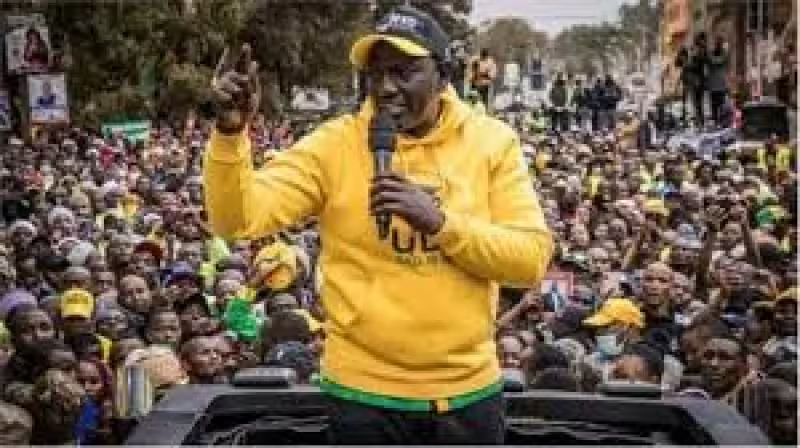
President William Ruto told Kenyans living in Italy on Monday that “If you listen to a Nigerian speaking, you don't know what they are saying - you need a translator,” praising Kenyans’ English and asserting, “Our education is good. Our English is good. We speak some of the best English in the world.”
Ruto went further, calling Kenya’s workforce a strength, saying, “We have some of the best human capital anywhere in the world. We just need to sharpen it with more training.” The remarks were captured on video and, according to a local news outlet, first posted online on April 20; they have since drawn fierce condemnation from Nigerians and other Africans across social media.
The criticism has been blunt and personal. Social media users pointed out that Nigeria has produced a Nobel Prize winner for literature and argued that both countries speak good English in different styles. Writer Hopewell Chin'ono weighed in, saying, “English is a colonial language, not a measure of intelligence, capability, or national progress,” while commentator Shehu Sani accused Ruto of mocking “the English of the country with a Nobel Prize for literature winner.The Nation of Achebe and Chimamanda.”
Contextual reporting underscores why the exchange cut deep. Both Kenya and Nigeria are former British colonies that use English as an official language, but they speak distinct varieties shaped by different histories and many local languages. The noted that Nigeria has more than 500 languages that influence cadence and intonation, while Kenya’s Bantu, Nilotic and Cushitic mix gives rise to its own accents. Online back-and-forths between the two countries are frequent and often revolve around economic comparisons, pop culture, sport and political remarks.


The current flare-up followed a separate comment by Nigeria’s president. Punch reported that President Bola Tinubu, during a visit to Bayelsa State on April 10, said Nigerians were “better off” than people in Kenya and other African countries and urged citizens to be honest about economic conditions: “It is very important that we are honest with our people. Yes, I hear you from various angles of the economy. The fuel price is biting hard, but look around, let us thank God together, that you are better off. Listen to them in Kenya and other African countries and what they are going through. We will not look back. We will continue to fine way to ameliorate the sufferings of the vulnerable.” Daily Trust said Ruto’s remarks came in the wake of those comments, adding a political edge to what might otherwise have been a linguistic debate.
The exchange exposes a tension between proud national self-presentation and the realities of pan-African sensitivities. Social media users noted that both countries speak competent English but in different styles, and they seized on Ruto’s phrasing as dismissive. also reported there has been no official response from Ruto’s government to the backlash, leaving the controversy to play out largely on platforms where users from both countries trade barbs and arguments about history, culture and comparative fortunes.
The friction comes amid broader economic strains across the region. Reporting cited by Daily Trust points to rising fuel prices and other pressures that feed public frustration; Punch has documented Nigeria’s struggles with inflation, currency instability and erratic electricity supply, while Kenya has in recent years faced its own economic challenges and public protests. Those underlying conditions help explain why a remark about language can quickly become a proxy for debates about dignity, status and national standing.
The crucial unanswered question now is whether Ruto or his office will formally clarify or retract the comments. For critics, a public apology or clarification could defuse a social media storm and acknowledge the shared colonial history of English in Africa; for supporters, the president’s praise of Kenyan education and human capital will look like a defense of national pride. ’s note that no official response has yet been made leaves the next move — and its political consequences — squarely in the hands of Ruto’s administration.