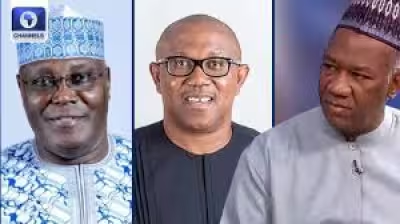





On Thursday Abdul Ningi told Politics Today on Channels Television that the Peoples Democratic Party can retain Bauchi State in the 2027 elections, insisting the party can win "with Bala or without Bala."
"PDP is the party to beat. We’ve been ruling over that state for more than 20 years; we are rooted in every ward, in every village," Ningi said, arguing the party’s local networks give it an advantage heading into 2027.
He doubled down on unity inside the party, telling viewers: "With Bala or without Bala, the PDP can still win Bauchi State, that I can assure you; PDP can still win." Ningi said once Governor Bala Mohammed chooses a successor inside the PDP "we don’t do anti-party… Whoever emerges as a gubernatorial candidate, we follow him," and added bluntly: "I don’t see any threat as far as other parties are concerned in Bauchi… I see them as just political rivals."
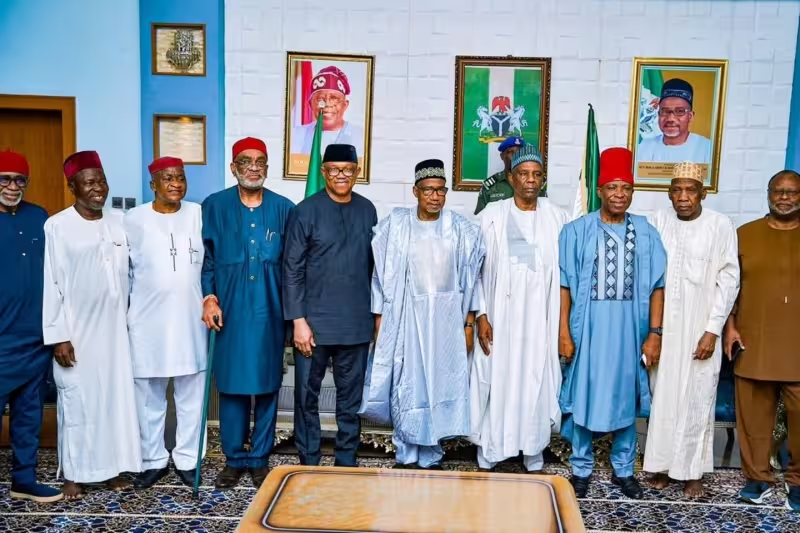
On the same day Governor Bala Mohammed hosted Peter Obi and a delegation of south-east leaders at the Bauchi State Government House, a string of recent meetings that have fed speculation about shifting alliances ahead of 2027. On March 31 Bala received leaders of the African Democratic Congress, including Babachir Lawal, and the following day he hosted Nentawe Yilwatda and Abba Yusuf amid talk of a possible exit from the PDP.
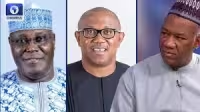
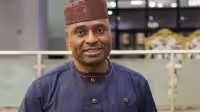
Bala described his own position in unusually personal terms during the visit from Peter Obi, saying: "I am a freelance now. Like, you know, we are freelance reporters, and he himself, his party, is in limbo. We are looking up to the judiciary," and adding that the south-east delegation had come seeking partnership. "What they are here for is not to ask us for anything other than partnership, cooperation, and synergy, to rekindle and rebuild the country, to recreate the balance of power that our forefathers created before, which has been abandoned," he said.
The two sets of statements—Ningi’s forceful assurances of party unity and Bala’s repeated claim to be "freelance"—set up a clear political tension. Ningi frames 2027 as a contest the PDP can win without depending on any single personality; Bala’s outreach to leaders from other parties and his public reference to the judiciary and to his own independence have been read by many as signals of a possible reordering of alliances.
Even as Ningi put a domestic cap on alarm—"I don’t see 2027 as a matter of life and death… It doesn’t matter if I don’t win the election in 2027, but as long as the party survives the turbulence of 2027, that’s why we’re here," he said—the exchanges expose a simple fault line: whether the party machine Ningi describes will actually mobilize behind a successor if Bala moves definitively outside the party.
For now the headline is Ningi’s confidence and Bala’s new label for himself. The consequence for readers is immediate: the real test of Ningi’s prediction will come as the PDP selects its gubernatorial candidate and as Bala’s engagements—with the ADC, with opposition figures and with the judiciary—produce concrete choices that could reshape alignments before 2027.