




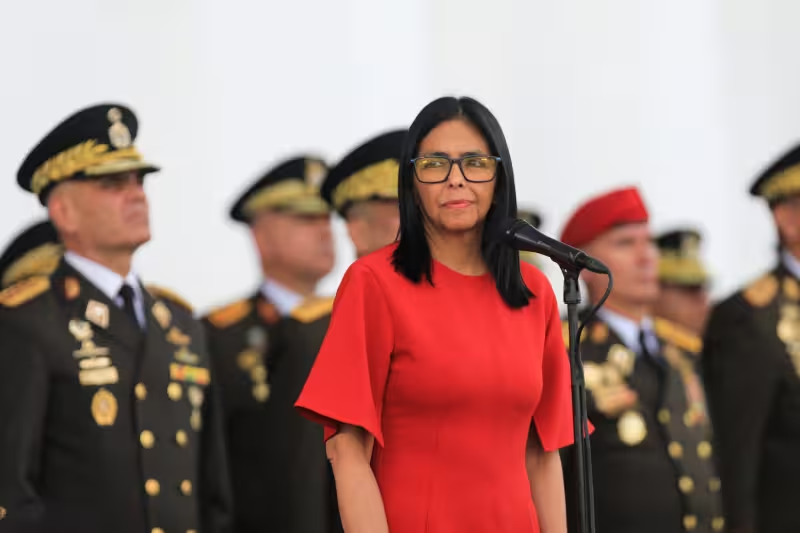
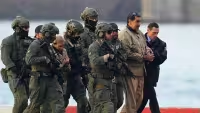
In Caracas, delcy rodríguez has presided over Venezuela’s executive apparatus since Nicolás Maduro was captured in a US raid on January 3, nearly a hundred days ago.
January 3 US Raid
The January 3 US raid on Caracas captured Nicolás Maduro, confirmed, and left Delcy Rodríguez, Venezuela’s vice president, in charge, confirmed. Frederick Kempe, president and CEO of the Atlantic Council, argued in a policy piece that “Washington needs a ‘Plan Venezuela’ before it’s too late,” a claim that presses the United States to treat Venezuela as an urgent strategic challenge rather than an end state of stability, claimed.
Plan Colombia 1999 Origins
The article compares the proposal for a Plan Venezuela to Plan Colombia, which began in 1999 under the Clinton administration, confirmed. That comparison invokes specific pre-Plan Colombia conditions: roughly half of Colombia’s national territory lacked a government security presence; the Revolutionary Armed Forces of Colombia numbered an estimated 18,000 fighters; the FARC had encircled Bogotá and controlled a demilitarized zone the size of Switzerland; Colombia recorded nearly three thousand kidnappings in a single year; and Colombia recorded close to sixty homicides per 100,000 people in a single year, confirmed. Those figures are presented as the historical baseline for what a US-led institutional rebuilding effort sought to reverse, claimed.
Venezuela: Rodríguez in Charge
Delcy Rodríguez is now the named executive authority in Venezuela after Nicolás Maduro’s capture on January 3, confirmed, and the article frames that interim authority as a window for diplomatic and institutional action rather than a permanent settlement, claimed. Frederick Kempe’s call for a Plan Venezuela explicitly urges Washington to design an extended institutional program modeled on Plan Colombia’s combination of security, governance and institution-building, claimed. The article warns Washington risks treating the breakthrough in Caracas as an end state — a course the piece presents as dangerous if the United States does not pursue a sustained program of rebuilding, claimed.
Delcy Rodríguez’s role places one individual at the center of the immediate political order in Venezuela, confirmed; Federico Kempe’s prescription frames the principal policy choice facing the United States: whether to invest in a long-term institutional effort akin to 1999’s Plan Colombia, claimed. The most urgent open question is whether the United States will move from the diplomatic recognition of an interim authority to funding and planning a Plan Colombia–style institutional rebuild before nearly a hundred days of interim governance calcify into a new status quo, disputed.