




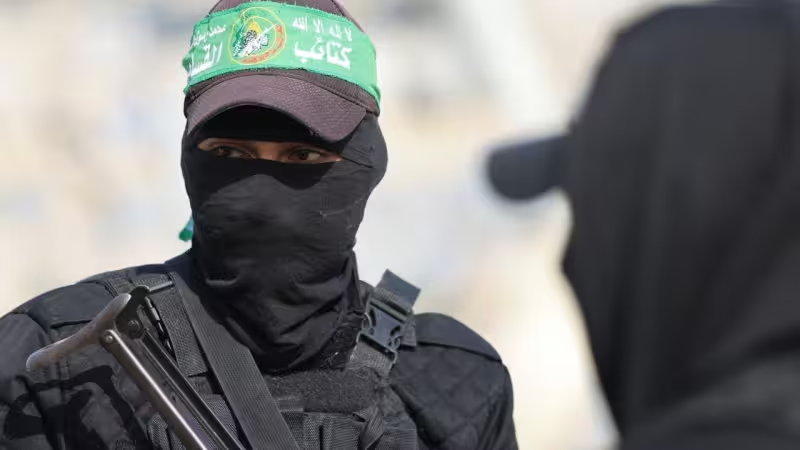
Mohammed Ouda, a veteran Hamas commander who served as head of military intelligence for the Qassam Brigades during the October 7 massacre, was killed in Gaza City after an Israeli strike on Tuesday night, the IDF and the Shin Bet said Wednesday morning.
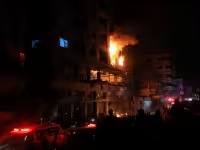
The israel defense forces and the Shin Bet said they had tracked Ouda and his top aides for months before simultaneously striking multiple buildings linked to a network of his potential hideouts. Officials said the military attacked one of Ouda’s top aides at the same time, and a grainy video distributed by the IDF showed buildings in Gaza City moments before huge explosions and smoke engulfed the area. The IDF said it confirmed Ouda’s death only after nearly 12 hours of assessing the effectiveness of the attack.
Prime Minister Benjamin Netanyahu and Defense Minister Israel Katz had said on Tuesday night that Israel had attempted the assassination, and the confirmation Wednesday morning closed that loop for Israeli leaders. The strike follows a pattern of targeted killings: the IDF assassinated Ouda’s predecessor, Iz al-Din al-Hadad, on May 15, and Israel killed Mohammed Deif in July 2024.
Ouda’s roots in Hamas stretch back decades. His work with the movement began around the First Intifada that broke out in 1987, and he served under Mohammed Deif for years. He led military intelligence for the Qassam Brigades during the October 7, 2023 invasion and was deeply involved in planning and in tracking IDF strategies throughout the war, the Israeli agencies said.
Reports say Ouda was reportedly offered the role of military head after the assassination of Mohammed Sinwar in May 2025 but turned it down at that time. Despite declining then, the article says he was later selected as one of the last remaining Hamas high command members with an active role in planning and supervising the October 7 attack, placing him among the few figures Israel has continued to target.


The killing exposes a narrowing of Hamas’s operational leadership. According to foreign reports, the only remaining member of Hamas’s core council is Imad Aqel, the home front commander, who did not participate in the October 7 attacks. That reality, paired with a steady stream of high-level assassinations since October 7, 2023, has left the group with fewer experienced commanders directly tied to the invasion.
Tension remains between what Hamas reportedly wanted of its remaining leadership and what Israel has pursued. Ouda’s earlier refusal of full command in May 2025 contrasts with Israel’s description of him as a central, active planner; that contradiction suggests the group was juggling limited choices among experienced officers even as Israel narrowed its list of targets. The IDF’s months-long tracking and the simultaneous strikes on aides underline a methodical campaign to remove coordinating figures rather than sporadic hits.
The immediate consequence is concrete: one of the architects of the October 7 invasion who had long worked inside Hamas’s intelligence structure is dead. The broader consequence is strategic. Israel has already eliminated several senior Hamas officials since October 2023, and the removal of Ouda further depletes the command that planned and supervised the massacre. That reduces the number of operatives with both the experience of October 7 and the institutional knowledge to rebuild similar operations.
What happens next is straightforward and consequential. With Ouda gone and his predecessor killed in mid-May, remaining Hamas leaders face harder choices about how to reorganize battlefield intelligence and planning under constant threat. For Israel, the strike represents another step in a campaign that has relied on targeted killings to disrupt cells and degrade command structures. For civilians in Gaza, the strike adds to a pattern of strikes on dense urban areas tied to specific targets.
Mohammed Ouda’s death closes a chapter on a commander whose involvement dated to the First Intifada and who, according to Israeli statements, played an active role in one of the deadliest attacks in recent regional history. Removing him narrows the pool of experienced planners and tightens pressure on the remaining leadership that, according to reports, now includes just a single core council member who was not part of the October 7 operation.