



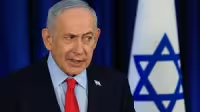
Benjamin Netanyahu said he had secretly visited the United Arab Emirates during the war with Iran and met President Sheikh Mohammed bin Zayed, a disclosure that his office said produced a historic breakthrough.
Netanyahu’s office described the talks as a landmark development; a news agency quoted a source saying the meeting took place in Al-Ain and lasted several hours. The prime minister’s admission was immediate and public, and it came as diplomats and officials across the Gulf reacted to weeks of cross-border strikes and missile exchanges.
The UAE foreign ministry rejected the account, calling the reports entirely unfounded and saying its relations with Israel are public and conducted within the framework of the Abraham Accords, not on non‑transparent or unofficial arrangements. The ministry also denied reports of any visit by Netanyahu or by an Israeli military delegation to the country.
The timing of the admission and the denial matters because the war with Iran has already sent military and diplomatic shockwaves through the region. Iran has struck targets in the Emirates during the conflict, and the UAE’s Ministry of Defence said on 10 May its air defences engaged two drones launched from Iran. The UAE also said it had engaged a total of 551 ballistic missiles, 29 cruise missiles, and 2,265 since the war broke out in late February.
Against that backdrop, the U.S. ambassador to Israel said Israel sent anti‑missile batteries from its Iron Dome system to help the UAE combat Iranian attacks. The ambassador called the deployment the result of an "extraordinary relationship between the UAE and Israel" forged through the Abraham Accords — a public diplomatic framework that the UAE has repeatedly insisted governs ties with Israel.


The president’s alleged trip surfaced amid other unacknowledged actions. A U.S. newspaper reported on Monday that the UAE had carried out strikes on Iran it had not publicly acknowledged, and named an early April strike on a refinery on Iran’s Lavan Island among the incidents. Those accounts, paired with Netanyahu’s admission, suggest a pattern of private operational cooperation running behind the region’s public diplomacy.
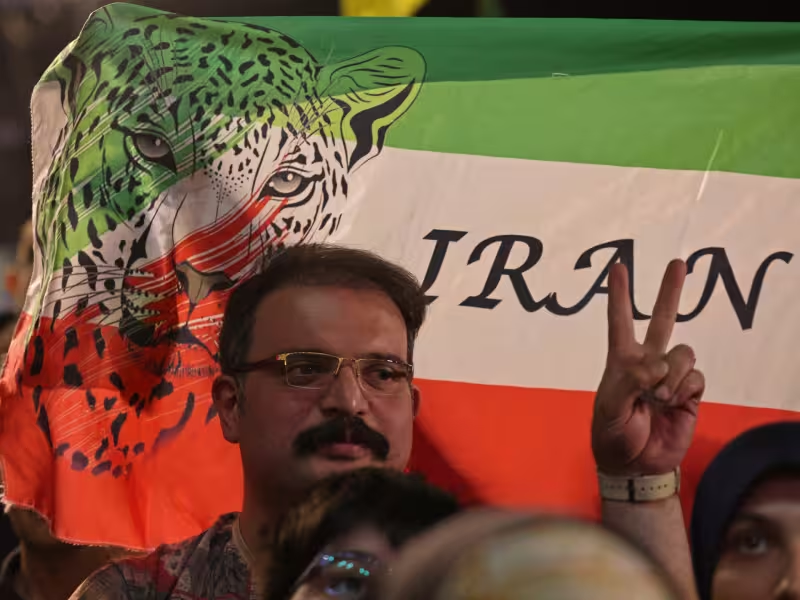
Iran’s foreign minister seized on Netanyahu’s remarks, saying the Israeli leader had publicly revealed what Iran’s security services had long ago told the country’s leaders and calling any collusion with Israel unforgivable and saying those responsible "will be held to account." The hard line in Tehran underscores how revelations about back‑channel contacts can widen the war’s diplomatic fallout.
Inside the UAE, presidential adviser Anwar Gargash said the country remained committed to diplomacy, had not sought the war and had worked to avoid it, and defended the UAE’s right to defend itself. Gargash also warned that "Arab‑Iranian relations in the Gulf cannot be built on confrontations and conflicts," a public reminder of the delicate balancing act Abu Dhabi has attempted between deterrence and diplomacy.
The immediate friction is plain: a public insistence by the UAE that its relations with Israel are transparent and governed by the Abraham Accords, versus claims that important security cooperation is being carried out quietly. That gap creates a political problem for the UAE — and for Israel — because admitting covert deployments or clandestine high‑level visits would conflict with the UAE’s stated posture and could inflame Iran further.
Netanyahu’s disclosure forces a single urgent test on the region’s emerging architecture: whether Gulf states can keep security assistance and quiet coordination separate from their public diplomatic ties, or whether such revelations will force those ties into the open and deepen Tehran’s response. The answer will determine whether the Abraham Accords remain a public framework for cooperation or a cover for covert operations that risk widening the war.