



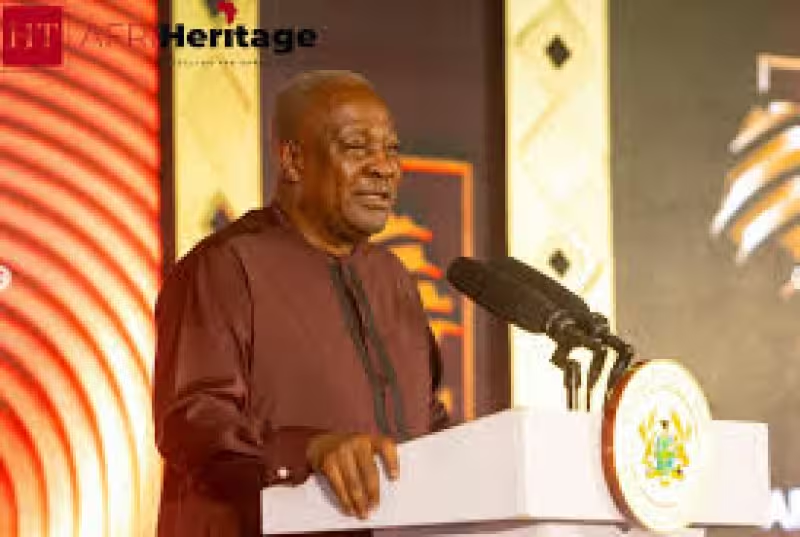
Ghana announced on Tuesday that it will evacuate 300 citizens from South Africa after a recent wave of protests and violence targeting foreign nationals, a move Foreign Minister Samuel Okudzeto Ablakwa said the president had approved as an "immediate evacuation" for those who had registered at the embassy in Pretoria.
Ablakwa, who described the people set to leave as "distressed," said the evacuation followed an advisory from Ghana's foreign ministry and instructions from the Ghanaian embassy in South Africa urging nationals to be highly cautious and to avoid public gatherings.
The number is small by South African standards — 300 people — but symbolic and urgent. The embassy also told nationals in Durban to shut their shops or businesses ahead of a protest planned for Wednesday, and the evacuation applies to those who had registered for rescue at the mission in Pretoria.
The developments came after South African President Cyril Ramaphosa said on Monday that the "protests and criminal acts directed at foreign nationals" did not reflect government policy and described the incidents as "isolated acts of criminality." Ramaphosa added that South Africa would "regulate migration, secure our borders and enforce our laws."
The day-to-day weight of the story rests on the diplomatic and practical ripple effects: Ghana and Nigeria recently summoned the South African envoys to their respective countries over the mistreatment and harassment of their citizens, and Ghana has written to the African Union asking it to discuss the issue. Other countries including Kenya, Malawi, Lesotho and Zimbabwe have warned their citizens in South Africa.

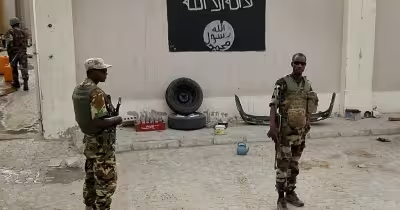
South Africa, for its part, has insisted it has "nothing to hide" and condemned the circulation of what it called "fake videos and images" that some people described as recordings of attacks on foreign nationals. That pushback sits uneasily beside the fact that thousands of South Africans joined protests against illegal immigration and demanded the mass deportation of undocumented foreign nationals — a reality that has in past years produced deadly outbursts.
Context matters here. Official figures show South Africa is home to more than three million foreigners, roughly 5% of the population, and xenophobia has long been an issue there. The evacuation by Ghana is the clearest immediate response to a cycle that mixes local anger over migration with periodic, sometimes violent, targeting of immigrants.
The tension is sharp: South Africa's leadership is asserting these are isolated criminal acts while large street protests demanding mass deportations continue, and some governments say videos of attacks are circulating irrespective of official denials. Ghana called the situation a serious risk to the safety and wellbeing of Africans in South Africa when it escalated the case diplomatically, and the embassy advisories on Tuesday reinforced that assessment for Ghanaians on the ground.
For officials in ghana, the move to repatriate a defined group of registered, "distressed" citizens is both a safety response and a diplomatic signal. It tests whether assurances from Pretoria that the incidents do not reflect policy will be matched by protection for foreigners and effective policing where violence occurs.
The next stage is clear and consequential: the physical evacuation of the 300 who registered, the planned protest in Durban on Wednesday, and whether the African Union takes up the letter Ghana has sent. Round Time News has reported on related travel links, including Victor Attah International Airport launches first international flight to Ghana, and on domestic timing pressures such as Labour Day in Ghana to be observed nationwide on Friday, May 1, both of which frame the short-term logistics and calendar in which this evacuation occurs.
The most important fact now is simple: Ghana has moved from warning and diplomacy to action. That action will put pressure on South Africa to show whether its insistence that it has "nothing to hide" and that videos are "fake videos and images" will be matched by secure conditions for the millions of foreigners who live there and by measures that prevent future waves of violence.