



The Israeli military said it intercepted "a suspicious aerial target" in an area where Israeli soldiers are operating in southern Lebanon, and that no sirens were sounded in accordance with protocol.
The brief announcement landed amid a wider diplomatic push to steady a region shaking from repeated strikes: Lebanon’s Health Ministry reports Israeli attacks have killed 2,883 people and injured 8,787 people since March 2, and more than 40 defence ministers met Tuesday to discuss post-war plans to ensure safe passage through the Strait of Hormuz.
The meeting on Hormuz, intended to map out a multinational route to keep oil and shipping moving, will be led by the UK and France and included Japan’s Defence Minister Shinjiro Koizumi, who called the effort an "international public good." At the same time the US State Department announced a reward of up to $15 million for information about oil deliveries connected to Iran’s Islamic Revolutionary Guard Corps and its facilitators, undercutting with incentives what diplomats are trying to secure by agreement.
Those competing moves came as China’s Foreign Minister Wang Yi urged Pakistan to step up mediation efforts to help reopen the Strait of Hormuz, and as Tehran and Washington sparred over an Iranian counter-offer. Iran sent a 14-point proposal on Sunday laying out demands to end the war and reopen the Strait of Hormuz; Iran’s semi-official Tasnim news agency said the offer included an immediate end to the war on all fronts, a halt to the US naval blockade of Iranian ports, guarantees of no further attacks on Iran, compensation for war damage and an emphasis on Iranian sovereignty over the Strait.
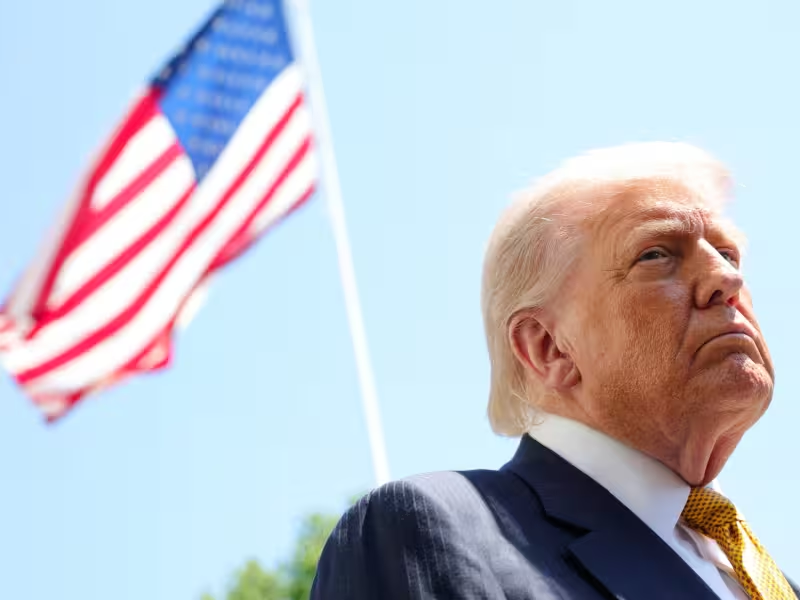
President Donald Trump rejected that proposal publicly on Sunday as "totally unacceptable" and "piece of garbage" on his social platform, then told reporters in the Oval Office on Monday that the month-long ceasefire between the US and Iran was on "massive life support" and was "unbelievably weak," even while saying the ceasefire technically remained in place.
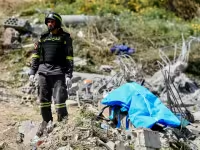
The juxtaposition between diplomatic bargaining and military cautions creates a sharp, awkward friction. Governments and ministers are trying to build structures for safe passage through Hormuz while the US is offering millions to choke off oil routes linked to IRGC networks; at the same time Tehran’s offer, as described by Tasnim, would end fighting immediately yet has been publicly dismissed by Washington. The interception in southern Lebanon highlights how the conflict plays out on multiple fronts even as negotiators scramble to contain its economic and naval fallout.
For residents near the border, the military wording carried a specific logic: no sirens were sounded because the army said the object posed a localised concern where troops were operating. But for diplomats in capitals from Tokyo to London, the episode is another reminder that tactical incidents can ripple into the much harder task of securing shipping lanes and stabilising a fragile ceasefire.
More than 40 defence ministers convened Tuesday to push planning forward for post-war safe passage, and the multinational mission designated to shepherd shipping through the Strait of Hormuz is to be led by the UK and France. Japan’s participation under Koizumi and China’s public urging of Pakistan to mediate signal how many hands are now on the task — and how many contradictory levers remain in play, from public rejections of Iran’s offer to $15 million rewards for cutting IRGC-linked oil flows.
The most consequential fact after two weeks of back-and-forth is blunt: with the US president dismissing Tehran’s terms outright and describing the ceasefire as barely alive, any framework for reopening the Strait of Hormuz depends less on technical guarantees than on whether Washington will move from public rejection to private compromise. If it does not, the interception in southern Lebanon will be read not as an isolated act but as part of a riskier pattern — tactical incidents that widen political gaps and make the diplomatic bridge to a durable ceasefire harder to build.
For now the region waits to see whether ministers and mediators can turn a 14-point offer and a crowded defence-room agenda into binding relief, or whether public denunciations and incentives to disrupt oil flows will widen the fault lines instead.
Related coverage: