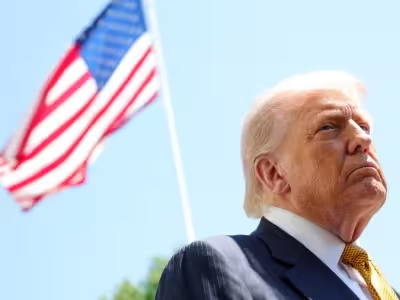




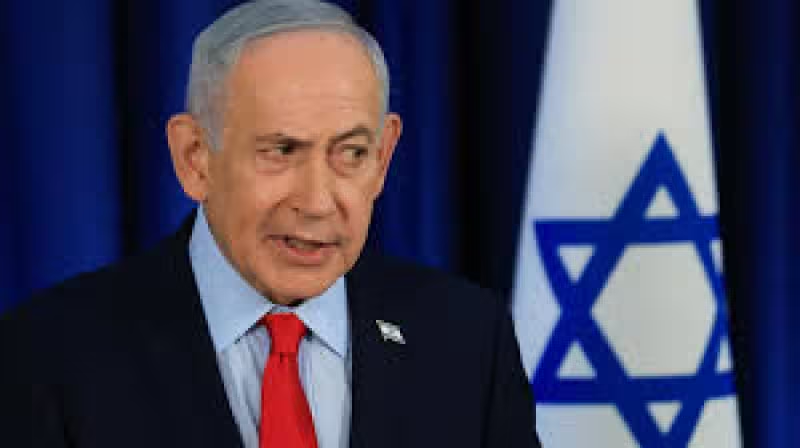
Benjamin Netanyahu this week released a video insisting he maintained full coordination with Donald Trump on the Israel Iran War, saying the two leaders spoke almost daily, even as U.S. press reports say Washington has stopped consulting Israel on the campaign.
The claim of tight alignment comes after a joint U.S.-Israeli assault on Iran on 28 February and reporting that Israel has been consulted even less about separate, Pakistani-brokered peace talks — signals that the relationship between Jerusalem and Washington may be fraying at a moment of maximum risk. Netanyahu portrayed continued close contact with the former president as proof of unified purpose; U.S. coverage of the conflict suggests otherwise.
Those differences matter because of how this confrontation was set in motion. Netanyahu spent decades urging American presidents to join Israel against Iran and played a pivotal role in persuading Donald Trump to withdraw the United States from the 2015 nuclear deal in 2018, a move that accelerated Iran’s nuclear programme and helped it amass highly enriched uranium sufficient for a dozen nuclear warheads. Reporting in the U.S. press says Netanyahu was again instrumental in convincing Trump, in February this year, that military action was the only viable response — and that message preceded the 28 February assault.
Allies and former officials say Netanyahu used a sequence of arguments to prod the White House. According to one interlocutor, he urged Trump to look at how a recent U.S. operation in Venezuela had effected regime change, argued that Iran’s economy was collapsing, suggested popular revolt was imminent, and portrayed the Islamic Revolutionary Guard Corps as losing its grip. He also flagged Iran’s remaining stockpile of highly enriched uranium — about 450kg by reporting — as a looming existential threat.

Inside Israel, the intelligence chief’s messaging reinforced the push to Washington: Mossad director David Barnea helped frame the Tehran regime as brittle and on the verge of collapse. That narrative, paired with persistent private lobbying, is the backdrop to Netanyahu’s public claim of coordination with Trump, and to the operations the two countries have since carried out.
But the public picture is messier. Domestic reporting in the United States says Washington has ceased regular consultation with Netanyahu over the Iran campaign; other reports say Israel has been consulted even less on parallel diplomatic moves, such as Pakistani-brokered peace talks. Political analyst Dahlia Scheindlin said she was alarmed by the discrepancy between Netanyahu’s rhetoric and what seems to be happening behind the scenes, and warned she would not be surprised if the war’s course has already slipped from Israel’s intended script because it is performing badly against its original goals.
The contradiction — Netanyahu’s insistence on daily, full coordination and U.S. reports of sidelining — is the central tension. If Israel’s prime minister spent years building ties to bring the United States into a conflict and to fracture the 2015 deal, his public posture now clashes with signs that Washington may be decoupling itself from his strategy. That gap matters not just politically but militarily: the U.S. and Israel carried out a devastating assault on 28 February, yet the broader campaign shows no sign of ending.
The immediate question is whether this apparent cooling will change how the war is fought. If Washington truly reduces consultation with Netanyahu, Israel may lose its most persuasive advocate in the U.S. policy process — and the cross-border cooperation that produced the 28 February operation could become harder to sustain. Netanyahu’s video insists coordination remains intact; the evidence of fractured ties suggests the opposite, and the war he long sought to draw the United States into looks set to continue without a clear alignment between its most vocal proponents.