



Iran said this week it had sent its response to US proposals to end the war, and Pakistan's Prime Minister Shehbaz Sharif said Sunday that his government had received that response — though he would not disclose a single detail. Sharif's refusal to share the contents leaves negotiators and markets guessing at what Tehran offered and what Washington will accept.
The stakes are concrete. Reports say the US proposals center on a one-page, 14-point memorandum of understanding that could open talks on Iran's nuclear ambitions. A US news outlet reported that the memo includes a suspension of Iranian nuclear enrichment, the lifting of sanctions and restoring free transit through the Strait of Hormuz; that report cited two US officials and two other unnamed sources, and said many of the memo's terms would be contingent on a final agreement. Iran's Isna news agency said Tehran's response focuses on ending the war and maritime security in the Gulf and the Strait of Hormuz.
The timing matters because the ceasefire meant to facilitate negotiations — agreed when the US and Israel launched strikes on Iran on 28 February — has been largely observed, even as the Gulf remains dangerous. The Strait of Hormuz is not abstract geography: around a fifth of the world's oil and natural gas usually flows through it. Iran has continued to block the strait, a move that has pushed world oil prices higher, while the United States has enforced a blockade of Iranian ports to increase pressure on Tehran to accept US terms.
The human voice is unmistakable in Tehran. Iranian President Masoud Pezeshkian urged defiance on Sunday: "We will never bow our heads before the enemy, and if talk of dialogue or negotiation arises, it does not mean surrender or retreat." That posture sits beside blunt military warnings. A senior Iranian military spokesman, Mohammad Akraminia, told seafarers they would face "severe consequences" if they did not cooperate with Tehran and added that "Americans will never be able to turn this vast expanse in the northern Indian Ocean into a real blockade by covering it with their fleet."
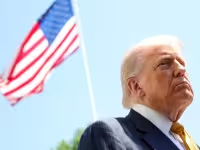
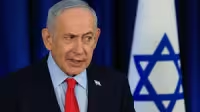
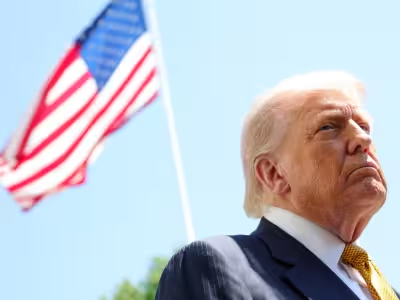
The international political chorus underlines the friction. US President Donald Trump predicted this week the war in Iran will be "over quickly" and said most people "understand" his goal of ending Tehran's nuclear ambitions. Israeli Prime Minister Benjamin Netanyahu answered with his own red line: "There's still enrichment sites that have to be dismantled." Netanyahu's demand — that Iran's enriched-uranium stockpile be neutralized before any end to hostilities can be declared — directly collides with reports that the US memo would make suspension of enrichment a central, but possibly temporary, term.
The clearest tension in the moment is practical: a largely observed ceasefire exists alongside an effective blockade of the Strait of Hormuz. Iran warns neighbours against complying with US sanctions and has in some instances attacked vessels trying to transit the strait. At the same time, Washington maintains a naval and economic pressure campaign, including the blockade of Iranian ports, to force Tehran to the negotiating table. Pakistan's role is opaque; Sharif confirmed his government holds Iran's reply but declined to reveal anything, saying only that it had been received. That silence prevents outside parties from assessing whether Tehran has made concessions sufficient to reopen Hormuz and calm markets.
If the unpublicized US memo does, in fact, hinge on a suspension of enrichment in exchange for lifting sanctions and restoring free transit, the next moves will be decisive and fast. Negotiators must determine whether the Iranian reply accepts, amends or rejects that framework; whether any acceptance is conditional; and whether Israel — which insists on dismantling enrichment sites — will approve a deal that stops short of demolition. Oil markets, already nudged higher by the blockade, are watching for any credible sign that shipping through Hormuz will resume.
The single most consequential unanswered question is stark and immediate: will Tehran agree to suspend enrichment long enough, and with enough verification, to secure the lifting of sanctions and the reopening of the Strait of Hormuz — or will it hold out, keeping the blockade in place and prolonging higher energy prices and military pressure? Pakistan's quiet custody of Iran's reply has bought the international community a day or two of suspense; what comes next will tell whether that pause becomes a pathway to diplomacy or the prelude to further escalation.