




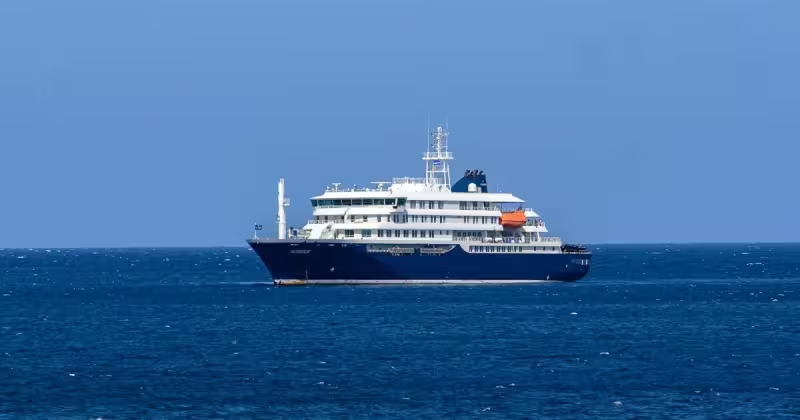
Two people in serious condition evacuated from the cruise ship MV Hondius arrived in the Netherlands for treatment, the World Health Organization said, while a third passenger in stable condition was on an evacuation flight that had been delayed. WHO director-general Tedros Adhanom Ghebreyesus said, "The patient had responded to an email from the ship's operator informing the passengers of the health event," and added that "at this stage, the overall public health risk remains low."
The number of cases and the international spread are the clearest measures of how big the problem has become: eight people who were on the MV Hondius have been identified with hanta virus, including three confirmed and five suspected cases, and three people who were aboard the ship have died since it set sail from Argentina about a month ago. The three evacuees who left the vessel were British, Dutch and German, and South African testing identified the Andes strain of the virus in two of the confirmed patients.
Officials in several countries have been pulled into the response. A man who disembarked in Switzerland later tested positive for hantavirus and is receiving care at a hospital in Zurich. Two U.S. states said they were monitoring passengers who had returned home after disembarking earlier: Georgia reported two residents were being monitored and were in good health with no signs of infection, and Arizona said one resident was being monitored and was not symptomatic. South African authorities identified 62 contacts, traced 42 people and placed them under observation.
Those figures sit alongside a practical problem at sea. The MV Hondius was anchored for three days near Cape Verde before sailing toward Spain's Canary Islands, a decision that drew objections from regional officials in Spain. Fernando Clavijo, leader of the regional authority, said bluntly: "There is no information that justifies why the vessel must sail for three days to the Canary Islands." Spanish health officials have planned to receive the vessel in Tenerife and said passengers could return home if medically fit to travel.



The timeline of individual illnesses underlines how the outbreak has threaded through multiple countries. A Dutch woman left the ship at St Helena on 24 April after her husband had died on board on 11 April; officials said he was not a confirmed case. The Dutch woman was briefly aboard a KLM flight from Johannesburg to Amsterdam on 25 April before crew decided not to let her fly because of her medical condition; she travelled to South Africa and died there on 26 April. Oceanwide Expeditions, the ship's operator, said the German evacuee was closely associated with a German woman who died on board the ship on 2 May.
Passengers remaining aboard the MV Hondius — 146 people from 23 countries — have been kept under strict precautionary measures as authorities investigate. Passengers were told to maintain distancing, wear masks and follow strict hygiene practices; dining was modified with spaced seating and sanitiser stations installed throughout the vessel. The WHO has reported eight cases among those who were on board and said the ship operator had informed passengers of the health event.
The friction in this episode is clear: public health authorities and a ship operator are acting on a moving set of facts while national and regional governments weigh the risks of allowing a vessel to dock and people to travel home. Spain says it will allow the ship to dock in Tenerife to enable medical assessments and repatriation for those fit to travel, even as some local officials question the decision. At the same time, laboratory confirmation of the Andes strain in South Africa and cases that surfaced after passengers disembarked in Europe and Switzerland have turned this from an onboard containment problem into an international contact-tracing exercise.
The immediate test is straightforward and consequential: can Spanish authorities screen and clear passengers in Tenerife without seeding further cases onshore? If the ship is allowed to dock and passengers are repatriated after medical checks, the handling of those returns — and the follow-up tracing in countries where former passengers have already travelled — will determine whether the WHO's assessment that "at this stage, the overall public health risk remains low" holds up.