



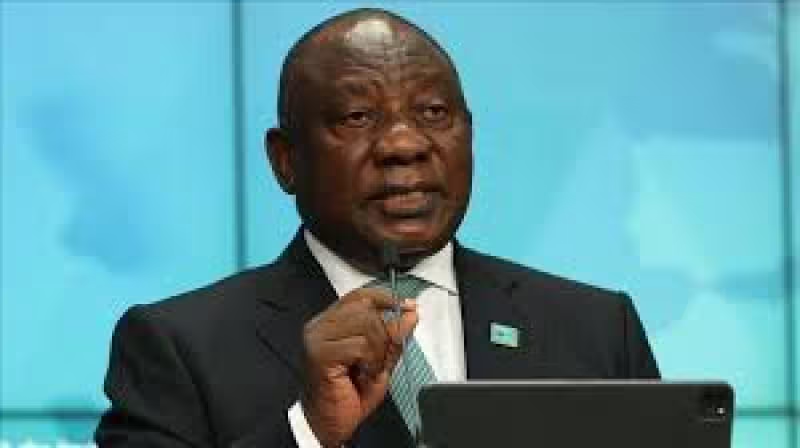
The Constitutional Court has ruled that parliament violated the constitution when it blocked efforts in 2022 to impeach President Cyril Ramaphosa, a decision that opens the door to renewed impeachment action.
The ruling follows a legal challenge brought by Julius Malema's Economic Freedom Fighters and others, and could lead to fresh impeachment proceedings against cyril ramaphosa now that the court has found parliamentary action unlawful.
The origins of the dispute trace back to 2020, when about $580,000 in cash was allegedly stolen from Ramaphosa's Phala Phala farm in Limpopo province; the money was later reported to have been hidden in a sofa. An independent panel in 2022 concluded the president may have a case to answer, and three people are currently on trial over the alleged theft.
In 2022, parliament voted 214 to 148 against setting up an impeachment committee, a defeat for those pushing to investigate the matter more fully at the time. The vote happened while Ramaphosa's African National Congress still held a majority in the assembly; after the 2024 general election the ANC now governs in a coalition, changing the political arithmetic that once shielded him.
Ramaphosa's office responded to the court's decision by saying the president respects the judgement and reaffirms his commitment to the Constitution, the independence of the judiciary and the rule of law. The office said he has been consistent in providing his full assistance to all inquiries into the matter and stressed that no person is above the law, urging that any allegations be subjected to due process without fear, favour or prejudice.
Julius Malema, whose Economic Freedom Fighters joined the African Transformation Movement in taking the case to the country's highest court in 2024, said the ruling intensifies pressure on the president and called for him to step down. Malema said Ramaphosa should focus on the impeachment process because it carries serious implications for him personally, arguing the evidence will be before parliament's eyes and warning that he cannot keep serving in the job while the allegations hang over him.
Opposition figures urged parliament to act. Cape Town's mayor, Geordin Hill-Lewis, said the chamber must now uphold the rule of law and that its impeachment committee must proceed properly, rationally, fairly and constitutionally. That message underscores a new strain of expectation: with the court's ruling, lawmakers who earlier declined to set up a committee now face a legal and political obligation to revisit the matter.
The factual knots at the centre of the case are narrow and concrete. South African rules require foreign currency to be deposited with an authorised dealer such as a bank within 30 days; critics have questioned whether handling the $580,000 complied with that requirement. Ramaphosa has denied wrongdoing and has maintained his explanation that the cash came from the sale of a buffalo.
The tension in the story is straightforward. Parliament's refusal to establish an impeachment committee in 2022 was lawful only because the ANC had a majority; the Constitutional Court has now judged that vote a constitutional breach. The political terrain has shifted since the 2024 election, removing the automatic majority that once insulated the president and leaving the new, coalition-era parliament to decide whether to re-open the process.
The single immediate question is what parliament will do next: whether its ethics and impeachment mechanisms will be reactivated, and whether a properly constituted committee will recommend formal charges that could lead to a full trial in the assembly. That decision will determine if the court's ruling remains a legal correction or becomes the start of a political process that could unseat a sitting president.