




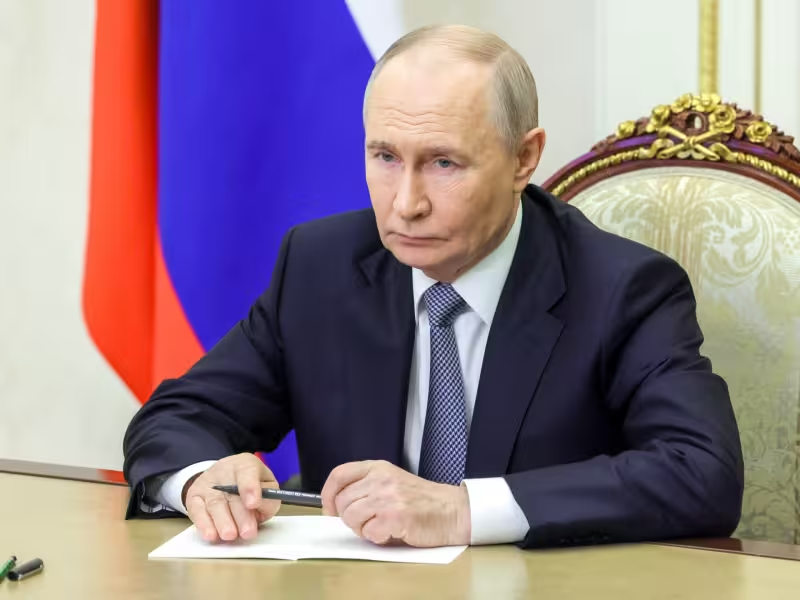
Russia test-fired a new intercontinental ballistic missile on Tuesday, and President Vladimir Putin announced the weapon would enter combat service by the end of the year.
Putin named the missile Sarmat and said of it, "This is the most powerful missile in the world." He told officials the nuclear-armed Sarmat has a range exceeding 35,000 km, is capable of suborbital flight and carries a warhead yield he said is more than four times greater than any Western equivalent.
The president framed the test as an upgrade to Russia's strategic forces: Sarmat, designated Satan II in the West, is meant to replace about 40 Soviet-built Voyevoda missiles and, Putin said, matches the Voyevoda for raw power while delivering higher precision. Development of the Sarmat began in 2011 and Putin first unveiled it publicly in 2018; before Tuesday the missile had only one known successful test and reportedly suffered a massive explosion during an abortive test in 2024.
The raw numbers Putin offered underline the scale he is promising: a global range measured in tens of thousands of kilometres and a claimed warhead yield many times greater than Western equivalents. He also said the Sarmat can perform suborbital trajectories, a capability he highlighted alongside the system's precision and destructive power, and he set a firm timetable for deployment — combat service by the end of the year.

That timetable lands against a changed arms-control backdrop. The last remaining treaty between Russia and the United States that capped strategic warheads and delivery systems expired in February, leaving the world's two largest nuclear powers without formal constraints for the first time in more than half a century. In the same month, the two countries agreed to reestablish formal, high-level military communications that had been suspended in late 2021.
The Sarmat announcement sits at the junction of capability and credibility. Putin's claim that the missile is both the most powerful in the world and more precise than the system it replaces is a clear political statement; yet the weapon's public test record has been thin. Until Tuesday there was only one known successful trial, and the 2024 abortive test that reportedly ended in a massive explosion raises questions about reliability even as officials present the program as mature enough for rapid fielding.
That gap — between grand claims and a limited test history — is the central friction in the rollout. Moscow can declare a system combat-ready, but independent verification of performance and consistency normally comes through repeated, successful trials and transparent inspection regimes tied to arms-control accords. Those mechanisms no longer bind the two countries, even as diplomatic channels have been restored, leaving a narrow corridor for officials to exchange technical data and reduce the risk of miscalculation.
For now, the clearest near-term consequence is procedural: Putin's deadline requires a flurry of activity from engineers, the Russian military and logistics planners to move from test launches to an operational posture before year-end. Given the missile's troubled test history and the recent explosion, meeting that schedule will test the program's technical resilience and the state apparatus behind it. The larger consequence is strategic: Russia's push to field a high-yield, long-range weapon at a moment when treaty restraints have lapsed increases the prominence of delivery systems in the bilateral relationship and in global calculations about nuclear posture.
Putin's decision to put a year-end marker on Sarmat's entry into service is a political choice as much as a military milestone. He is betting that speed and public demonstration of capability will matter more than the careful, verifiable progress that used to be enforced by treaties — a gamble that will shape the risk environment between the two nuclear powers for months to come.