


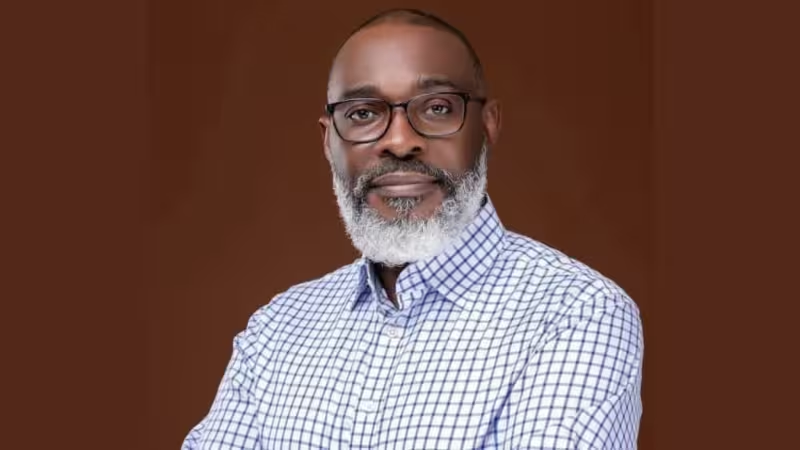
President Bola Tinubu on Monday appointed retired Major General Adeyinka Famadewa as his Special Adviser on Homeland Security, adding a new title to Nigeria’s security architecture and putting a veteran intelligence officer at the center of the administration’s internal security push.
The appointment was announced by the Office of the Secretary to the Government of the Federation, which said Famadewa would help improve coordination of homeland security initiatives, intelligence integration and proactive risk management in the effort to build a safer and more secure Nigeria.
The choice matters because it comes as security concerns remain acute across the country, with soldiers, policemen and other security agents being killed and security equipment being burnt. It also gives formal weight to a role that has been described as a new term in the security structure, at a moment when Nigerians are already arguing over whether the answer to insecurity lies in tighter coordination or in a broader rethink of strategy.
Famadewa is no outsider to that debate. Commissioned into the Nigerian Army Intelligence Corps in September 1990 as a member of the 37 regular course of the Nigerian Defence Academy in Kaduna, he has spent over three decades in military and intelligence service. His record includes service as chief instructor at the Nigerian Army Intelligence School in Lagos, deputy director of technical development at DIA, commander of the counter-intelligence command of the Nigerian Army and director of the intelligence production centre of the Nigerian Army. He also served in the United Nations Mission in Sudan as Sector J2.


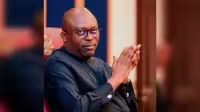
His background is unusually broad for a security appointee. Famadewa holds a bachelor’s degree in chemistry from the Nigerian Defence Academy, a master’s of business administration in management from the Federal University of Technology, Akure, and a master’s of strategic studies from the University of Ibadan. He also attended the junior and senior command and staff courses at the Armed Forces Command and Staff College in Jaji, security programmes at Harvard University’s Kennedy School of Government, the Canadian Forces College in Toronto, the George Marshall Center in Germany and the Galilee International Management Institute in Israel. He is a fellow of the National Defence College and his military decorations include the meritorious service star.
The appointment also lands in the middle of a public conversation Famadewa himself helped shape. In 2023, he argued that national security debates in Nigeria had been stretched over many years but often produced too little substance, saying the subject needed a meaningful and lasting response and that the responsible authority should first define what national security means for Nigeria. He wrote that security is the responsibility of the whole of society, government and nation, and compared relying on military force alone to using paracetamol to cure cancer. He also likened the country’s security conversation to Salt-N-Pepa’s song “Let’s talk about sex,” a line meant to capture how much is said and how little is settled.
That history is part of why the move is being read in more than one way. Daily Trust reported that some Nigerians saw the appointment as the right direction while others viewed it as politically loaded, with a security expert warning that there are overlapping functions between the National Security Adviser and the Special Adviser on Homeland Security. The expert said the National Security Adviser is an adviser while the homeland security role is closer to a ministerial function in the United States, and suggested the appointment could mean Nuhu Ribadu is no longer enjoying Tinubu’s trust and confidence.
Still, the official case for Famadewa is clear. SGF’s office described him as a highly decorated retired general with over three decades of distinguished military and intelligence service spanning national security strategy, intelligence fusion, counter-terrorism operations and international security diplomacy. It also said his career reflects a rare blend of operational excellence, strategic foresight and institutional leadership in safeguarding Nigeria’s territorial integrity and national interests.
Akume said the appointment underscored Tinubu’s commitment to strengthening internal security coordination, enhancing intelligence-driven operations and deepening inter-agency collaboration. The test now is not whether Famadewa knows the system. It is whether the system, with its overlapping mandates and mounting threats, is ready to let a new security adviser change how it works.