




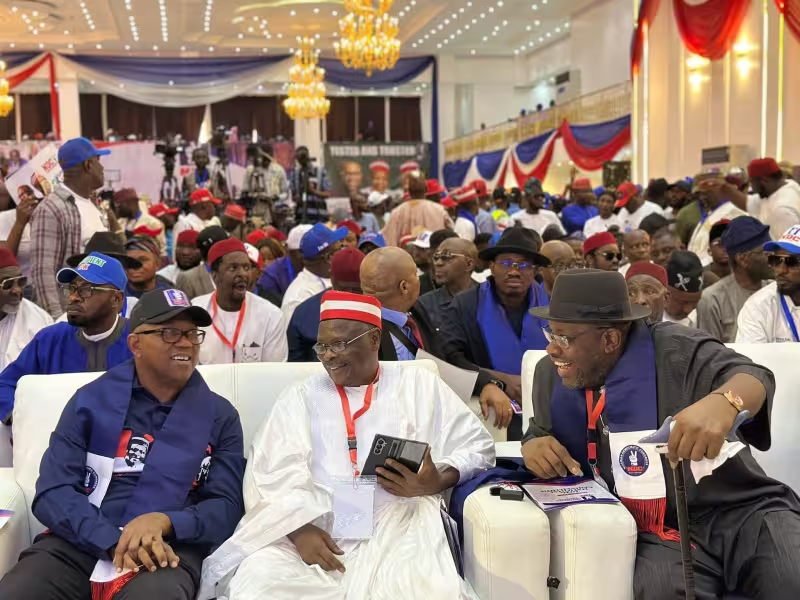
The Nigeria Democratic Congress has fixed May 29, 2026, for its presidential primary election in Abuja and published a compact schedule for forms, screening and party primaries in late May.
Under the timetable, the party says the sale of nomination forms will run from May 21 to May 23, with screening of candidates concluding by May 26. Primary elections for other elective offices are set for May 27 and May 28, leaving the party’s presidential contest to be decided on May 29 in the federal capital.
The NDC has set the presidential form at 60 million naira, a single fee the party says includes both the expression of interest form and the nomination form. To widen access, the party announced a 50 percent discount for female aspirants and a 25 percent discount for persons with disabilities. The party’s internal timeline also lays out earlier steps: sale of expression of interest forms running from May 13 to May 18, screening and interviews from May 19 to May 21, and an appeals window tied to screening running from May 25 to May 26.
The schedule plugs into the national electoral calendar issued by the Independent National Electoral Commission, which set a formal window for parties to hold primaries between April 23 and May 30, 2026. INEC also set May 10, 2026, as a deadline for parties to submit their membership registers and reiterated that registers must be submitted not later than 21 days before the holding of the respective primaries. National voting days sit months later: Nigeria will hold presidential and National Assembly elections on January 16, 2027, followed by governorship and State Houses of Assembly elections on February 6, 2027. Campaigning for the presidential and National Assembly contests begins on August 19, 2026, while campaigns for governorship and state assembly contests open on September 9, 2026.



The numbers underscore how compressed the run-up to the NDC’s internal contest will be. With nomination sales and candidate screening compressed into roughly two weeks, the party has scheduled its own primaries at the tail end of the national window allowed by INEC. The 60 million naira fee — even with discounts for women and persons with disabilities — is a headline figure that will shape who chooses to run and how aspirants budget for both expression and formal nomination.
The timetable contains two practical frictions. First, INEC’s rule that a party’s membership register be submitted not later than 21 days before its primaries puts a technical deadline in tension with the commission’s separate May 10 overall deadline. For a presidential primary on May 29, the 21-day rule would imply a register submission date of around May 8 — before the universal May 10 cut-off. That overlap leaves parties with little room for error in preparing and filing membership documents. Second, the party’s own appeals window from May 25 to May 26 ends just three days before the presidential primary, a narrow margin to resolve eligibility disputes and potential internal challenges ahead of voting in Abuja.
Media reports have noted that the NDC is among the later major opposition parties to publish an internal timetable, after other parties released their programmes earlier in the primary window. Some reporting has also presented a different breakdown of the 60 million naira fee, splitting it into a 20 million naira expression of interest and a 40 million naira nomination fee, while the NDC describes the total as a single combined price.
The most consequential question now is procedural: can the NDC complete screening, settle appeals and submit an accepted membership register to INEC within the narrow windows set by both the party and the commission so that the May 29 contest proceeds without legal hitches? How the party handles those deadlines in the coming weeks will determine whether its timetable delivers a clean nomination or fuels fresh internal disputes ahead of the national campaign season.