




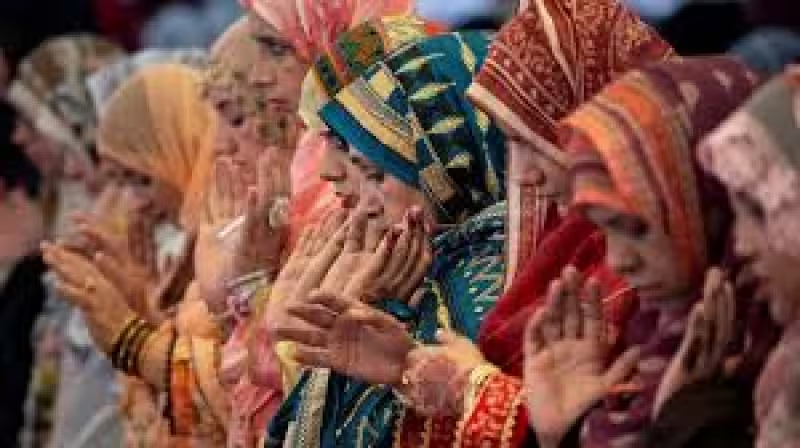
Wednesday, May 27, 2026 is the 10th of Dhu al-Hijjah and marks the day of Eid al-Adha, the annual festival that Muslims observe around the world.
Imam Zayn al-Abidin’s words, preserved in the Sahifa Sajjadiyya, are often read as the day arrives: he prays that this is a special and blessed day when Muslims are gathered across the corners of God’s land, among those who ask, seek, desire and fear, and that God observes their needs.
The calendar fact is simple and sharp: the 10th of the month of Dhu al-Hijjah is Eid al-Adha, and for 2026 that day falls on Wednesday, May 27. That date names the occasion and gives communities the moment at which the holiday’s public and private observances are centered.
For many people the holiday’s gravity resists neat description. Eid al-Adha has a feeling that’s hard to put into words: it is at once communal and inward, ritual and remembrance. For that reason, the recitation of devotional passages such as the supplication attributed to Imam Zayn al-Abidin is an enduring part of how the day is felt as well as marked.
Context matters here: the 10th of Dhu al-Hijjah is the fixed point on the Islamic calendar that defines Eid al-Adha, and that relationship is why the day carries its name and set of observances. The timeline of observances cited alongside 2026 includes earlier and alternate Gregorian anchors: Wednesday, August 22, 2018 marked Eid al-Adha in 1439 A.H., and the schedule also lists Monday, June 17 as a date associated with the 10th of Dhu al-Hijjah.

That overlap of dates is the story’s tension. The published timeline shows Wednesday, May 27, 2026 as the 10th of Dhu al-Hijjah and the day of Eid al-Adha, yet it also lists Monday, June 17 as marking the 10th of Dhu al-Hijjah. The two calendar points sit in the same briefing of facts, creating an unresolved discrepancy for anyone trying to reconcile Gregorian dates with the Islamic month in a single, neat conversion.
Readers should note that the article’s declared observance for 2026 is Wednesday, May 27, and that earlier observances are recorded on very different Gregorian dates — August 22, 2018 is cited for the 10th of Dhu al-Hijjah in 1439 A.H. — underscoring that the same holy day can appear on different dates in different years when translated into the civil calendar.
How people actually live the day is captured in small, repeatable acts and in a few lines of prayer. The supplication from Sahifa Sajjadiyya attributed to Imam Zayn al-Abidin asks for God’s attention to those gathered on the day and names a range of human conditions—asking, seeking, desiring, fearing—that make the festival more than ceremony.
Practically, for anyone marking the holiday in 2026 the clear, reportable fact is the observance date: Wednesday, May 27, 2026 is the 10th of Dhu al-Hijjah and the day of Eid al-Adha. That is the anchor around which families, communities and places of worship will arrange whatever rituals and remembrances belong to them.
The unresolved calendar points remain a consequential detail for planners and for readers tracing the day across years. But the essential human fact is unchanged: Eid al-Adha is a day that, as the records put it, feels hard to put into words, and the supplication of Imam Zayn al-Abidin continues to be read as a way to name what people hope and fear on that day.
So when people say “Eid Mubarak 2026” they are naming a date and invoking a long devotional history: Wednesday, May 27, 2026 is the 10th of Dhu al-Hijjah and, in that line of time and prayer, the day of Eid al-Adha.