




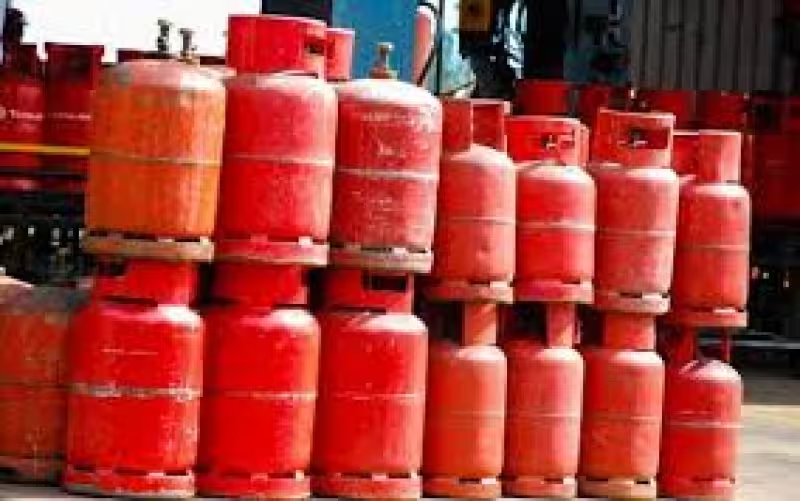
Cooking gas prices rose across parts of Lagos, Ogun and Abuja amid supply shortages and mounting operational costs, with some retailers charging as much as N2,000 per kilogram, industry officials said Monday.
Edu Inyang, national president of the Nigeria Liquefied Petroleum Gas Marketers Association (NALPGAM), told consumers and policymakers the increase has been rapid and painful. TheCable observed on Monday that prices peaked at N1,400 and N2,000 per kilogram across various locations, while other local checks show sharp jumps in Lagos and the Federal Capital Territory over the past weeks.
Local markets recorded a string of new high points: in Ikorodu, Lagos, cooking gas sold for N1,800 per kg, up from N1,300 almost a month ago; at Afeeze Bus Stop in Ogba, the price rose to N2,000 per kg from N1,500 within the last three weeks; in Akoka, Yaba, consumers paid N1,500 per kg; in Ojota the commodity sold for N1,400 per kg; and in the RCCG camp area in Mowe, Ogun state, prices hit N2,000 per kg. Outside the southwest, Owerri in Imo state recorded N1,500 per kg, while residents in Lugbe said they paid N1,480 per kg and consumers in Lokogoma reported N1,600 per kg on Monday.
The national picture is becoming one of uniformly higher retail prices. NALPGAM said consumers across the country now purchase cooking gas at more than N1,500 per kg and the association warned the crisis could worsen food inflation, force LPG businesses to shut down, trigger job losses and undermine Nigeria’s clean energy goals.



NALPGAM laid the blame squarely on what it described as persistent supply shortages, high depot prices, logistics bottlenecks and rising operational costs. The group said operators currently pay between N25.2 million and N26.2 million for a 20-metric-tonne truck of LPG depending on location — a figure the association repeated in a Sunday press statement and in remarks carried by national broadcasters. "The rising cost and erratic supply of cooking gas have imposed severe hardship on households, food vendors, small businesses and low-income earners who depend on LPG for daily cooking," NALPGAM said.
The increases have not been uniform in reporting. One national broadcaster put recent prices as high as N1,500 per kg from about N1,300 depending on the area, while another outlet reported that cooking gas now sells between N1,500 and N1,700 per kilogram. TheCable's observations on Monday added the higher peaks seen in pockets of Lagos and Ogun states.
The price shock is already altering behaviour at scale, according to reporting from local newspapers and NALPGAM. Daily Trust said many households were reverting to firewood and charcoal because of the high cost of cooking gas, a reversal that NALPGAM warned would undermine progress on clean-cooking targets. In its Sunday statement the association appealed for government and stakeholder action and issued a blunt warning: "We cannot stand by and watch millions of Nigerian families suffer in silence while access to clean cooking energy becomes increasingly unaffordable."
There is also an escalatory note in the association's rhetoric. "It is sad and rather very pathetic to inform the general public that the citizens of Nigeria have woken up to buy cooking gas, which should be a social item at a prohibitive cost of over N1,500 per kg, while the Marketers are made to pay as much as N25,200,000, or, depending on location, N26,200,000 for 20MT of cooking gas," NALPGAM said. The group added: "We feel that if the situation is not immediately checked, the citizens may rise against the owners of gas filling stations." Edu Inyang repeated the appeal for urgent government intervention: "It is sad and rather very pathetic to inform the general public that Nigerians have woken up to buy cooking gas, which should be a social item, at a prohibitive cost of over N1,500 per kilogram," he said, and warned once more that "we feel that if the situation is not immediately checked, citizens may rise against owners of gas stations."
The nigeria cooking gas price surge now faces a single hinge: whether federal authorities and industry stakeholders will step in quickly to stabilise supply and depot pricing. Without that intervention, NALPGAM's own figures and the patchwork of market checks suggest higher retail costs, a renewed turn to charcoal and firewood, and pressure on small traders and food sellers — the very outcomes the association says the country must avoid.