




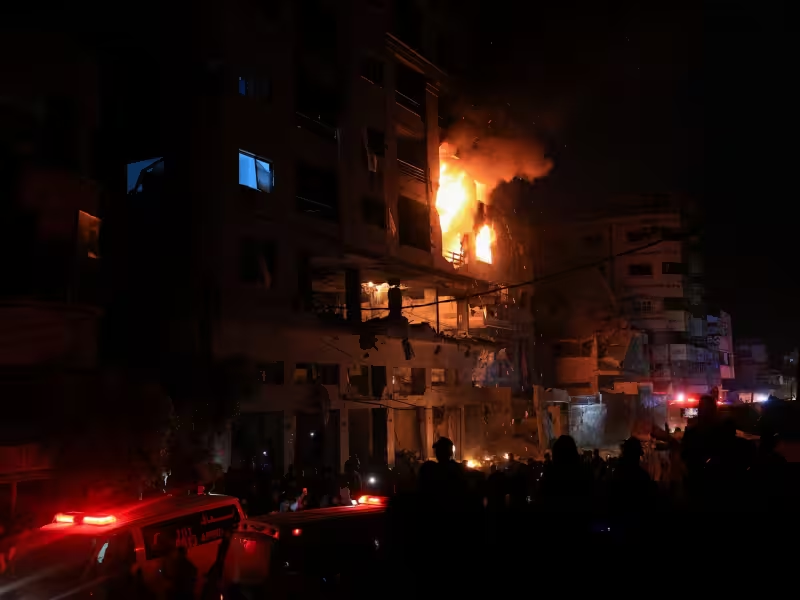
At least seven Palestinians were killed in two Israeli air strikes on Friday in Gaza City, officials said.
Mahmoud Basel, who spoke from the scene in the Rimal neighbourhood, said a residential building was hit and that hundreds of people had been living inside. "The missile was fired without any pre-warning or notification. We are talking about a number of [dead]. We are talking about a big number of wounded, among them families," he said.
Local health authorities said three women and one child were among the civilians killed. One of the strikes hit a civilian vehicle and killed three Palestinians, while another struck a residential building in Rimal in western Gaza City and killed four. At least 45 others were injured, several reported in critical condition.
Israel said it carried out a strike on Izz al-Din al-Haddad, whom it named as the head of the armed wing of Hamas in Gaza. Prime Minister Benjamin Netanyahu and Foreign Minister Israel Katz described the target as "one of the architects" of the October 7 attacks. The joint Israeli statement did not say whether Haddad was killed. Hamas had not commented on the strike in the primary article.
The strikes fell on the 78th anniversary of the Nakba, the mass displacement tied to the 1948 war that created Israel. The anniversary day is observed across Palestinian communities and comes as Gaza remains densely populated after successive rounds of fighting — people who fled east Gaza have concentrated in western areas such as Rimal.


Gaza’s health ministry, which compiles casualty figures for Palestinian authorities in Gaza, says that since the ceasefire established last October close to 850 Palestinians have been killed in Israeli attacks. That tally underlines the fragility of the truce: the primary article noted that fighting and strikes have continued despite the ceasefire framework reached last autumn.
The Israeli statement linked Haddad to the October 7 attacks and said he opposed disarming Hamas and demilitarising Gaza. Israeli officials framed Friday’s operation as a targeted move against a senior militant figure; the civilian dead and wounded, and Basel’s account that hundreds lived in the struck building, highlight the human cost of raids in densely populated neighbourhoods.
The contradictions are stark. Israel named a senior militant as its target but provided no public confirmation of a kill; nearby residents reported no warning and said the strike hit a building full of families. One strike also struck what local authorities called a civilian car. Hamas’s lack of comment, at least in the primary reporting, leaves local witnesses and health officials to document the immediate toll.
For Gazans who mark Nakba Day as a day of displacement and mourning, the timing amplified outrage and fear. The Rimal area has become more crowded as people moved there from the east of the city seeking shelter from earlier operations; residents and medics say that crowding raises the likelihood that strikes aimed at militant figures will hit civilians.
The single unanswered, consequential fact from Friday’s strikes is whether Izz al-Din al-Haddad was killed. Israel named him as the target and called him "one of the architects" of October 7; until that point is clarified, the strikes will stand as a bitter ledger of civilian loss and a potential trigger for further escalation in Gaza.